
How to Use AI in Restaurant Hiring
TL;DR
Restaurant managers are not hiring professionals. They are operators who also have to hire, and the manual work of posting jobs, screening applicants, and scheduling interviews pulls them away from the floor. AI hiring tools take those repetitive tasks off the manager's plate so the process runs faster and more consistently without adding more work for teams already stretched thin.

Lyuba


How to Use AI for Restaurant Hiring
Restaurant managers are not hiring professionals. They are operators who also have to hire, and the difference matters. Every minute spent sorting through applications or chasing interview confirmations is a minute not spent on the floor, managing service, or developing the team already working for them. The administrative weight of hiring in a high-turnover environment is real, and it compounds fast.
Learning how to use AI in hiring does not require a technology background. It requires understanding which parts of the process are eating up the most time and replacing them with something that runs without constant attention. This guide covers everything operators need to know about how to use AI in restaurant hiring without overcomplicating the process or adding more work for already stretched managers.
Why Restaurant Hiring Is So Difficult
The core problem with restaurant hiring is that it rarely happens on a schedule. Someone quits on a Tuesday, a shift opens on Friday, and the manager is now dealing with last-minute restaurant staffing while posting a job, reviewing resumes, scheduling interviews, and running a full floor at the same time.
Reducing time-to-hire is not just a convenience goal. Every day a position stays open affects service quality, puts pressure on the existing team, and increases the likelihood that restaurant staff turnover compounds before the next hire is even close to starting. Operators who want a practical framework for how to use AI in restaurant hiring will find the biggest returns in the parts of the process that currently consume the most manager time.

What AI Actually Means in Restaurant Hiring
The word AI makes a lot of restaurant operators tune out immediately. It sounds expensive, complicated, and built for companies with a dedicated HR team and an IT department. That is not what AI in restaurant hiring actually looks like in practice.
AI in this context means software that handles the repetitive, administrative parts of hiring automatically. Resume screening. Interview scheduling. Candidate follow-ups. Job description drafting. These are not tasks that require human judgment at every step, but they consume hours of manager time every week because someone has to do them. AI tools take that work off the manager's plate, so the decisions that do require judgment, who to hire, who to move forward, who to pass on, get the attention they deserve.
How Restaurants Can Use AI in Hiring
1. Use AI to Write Better Job Descriptions
Generic job descriptions attract generic applicants. A posting that says "looking for a motivated team player with a passion for hospitality" tells a candidate almost nothing about the actual job, the schedule, the pay, or the expectations. The result is a high volume of applications from people who are not a fit, which creates more work for the manager reviewing them.
AI-generated job descriptions help operators get specific quickly. They produce postings that clarify shift expectations, experience requirements, availability needs, and compensation without the manager having to start from scratch every time. An AI job description generator built for restaurants produces descriptions that filter out unqualified candidates before they apply, which reduces the volume of applications that need to be reviewed and improves the overall quality of who comes through.
2. Use AI for Resume Screening
Reviewing every application manually is one of the most time-consuming tasks in the hiring process, and it is also one of the easiest to improve. Most applications for hourly restaurant positions can be evaluated on a small number of criteria: relevant experience, availability, proximity to the workplace, and shift compatibility. A manager does not need to read a full resume to determine whether those four things are present.
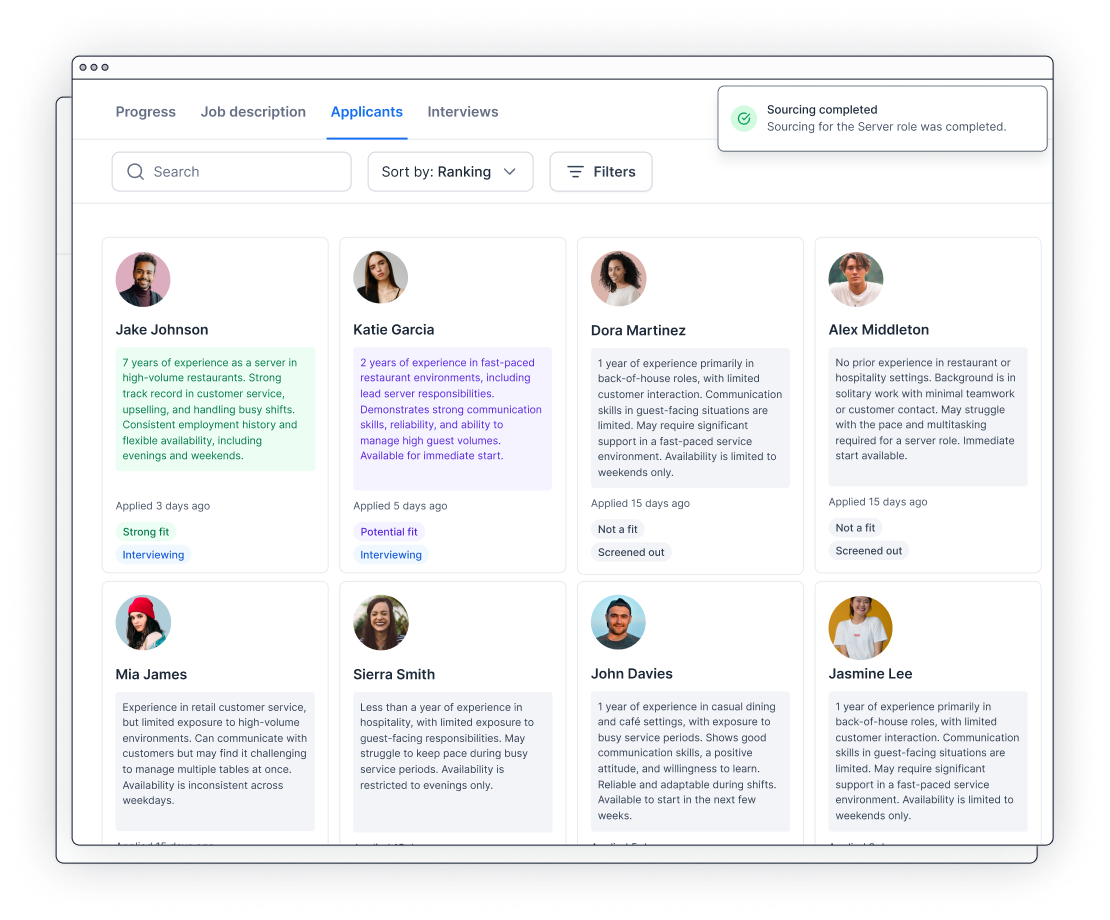
Ai candidate screening tools identify which applicants meet the baseline requirements and surface them first, so managers spend their review time on candidates who are actually worth interviewing rather than sorting through the full stack. The decision still belongs to the manager. The sorting does not.
3. Use AI to Coordinate Interviews Automatically
Interview scheduling creates more friction in the restaurant hiring process than most managers realize. A candidate applies, the manager responds a day later, the candidate suggests a time, the manager is in a rush and misses the message, and by the time the interview is confirmed, the candidate has already accepted a job somewhere else. That sequence happens constantly in high-volume restaurant hiring.
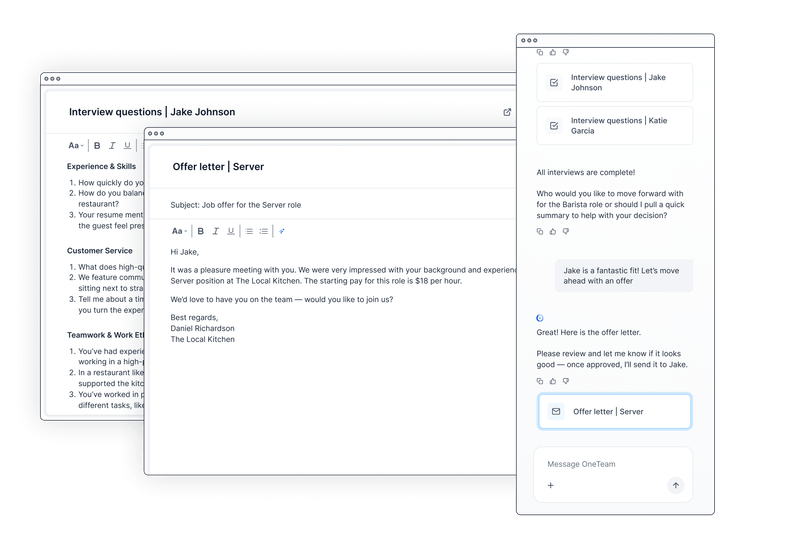
The benefits of automated interview scheduling go beyond saving time on confirmations. AI tools send interview invites, offer available time slots, handle rescheduling, and send reminders before the interview to reduce no-shows. The result is a faster process that improves the candidate experience and keeps qualified applicants engaged long enough to actually show up.
4. Use AI to Keep Candidates Engaged
The window between application and hire in restaurant hiring is short, and slow communication closes it fast. Candidates applying for hourly positions are almost always applying to multiple restaurants at the same time. The first operator to respond, confirm, and move forward typically gets the hire. Silence loses candidates to faster competitors, and that loss is invisible because the manager never knows the candidate was accepted somewhere else.
An AI hiring assistant automates follow-ups, confirmations, and status updates so candidates stay informed throughout the process without requiring the manager to send individual messages. The communication happens in the background. The candidate feels attended to. The manager stays on the floor.
5. Use AI to Build a Long-Term Hiring Process
Most restaurants hire from scratch every time someone leaves. The job gets posted, applications come in, and the process starts over with no foundation from previous hiring cycles. That approach is inefficient, and it is one of the reasons reactive hiring stays reactive.
AI helps operators build a hiring process that carries forward. Past applicants who were not hired for one opening may be a strong fit for the next one. Operators who want to go beyond their existing applicant pool should look at how to source candidates for roles that consistently stay open longer than they should.
OneTeam is built to function as an ongoing hiring assistant rather than a tool managers pick up once and put down, which is what turns a reactive hiring cycle into a structured one.
Benefits of Using AI in Restaurant Hiring
The operational case for AI in restaurant hiring comes down to time, consistency, and quality. Managers who spend less time on administrative hiring tasks spend more time on the floor. Hiring processes that run consistently produce more consistent hires. Restaurants that actively use AI in restaurant hiring report the most immediate gains in speed of hire and reduction in administrative work across both front-of-house and back-of-house roles.
Key benefits restaurant operators see when they start using AI hiring tools:
- Faster time to hire across all front-of-house and back-of-house roles
- Reduced administrative work for managers running the floor
- Higher quality applicants from better-written, more specific job descriptions
- Fewer interview no-shows through automated reminders and confirmations
- A more organized process that does not restart from zero every hiring cycle
- Improved candidate experience that keeps applicants engaged through the process
For restaurants trying to improve each of these areas at once, ai hiring software can help connect job descriptions, candidate screening, interview scheduling, and follow-up in one hiring workflow.
Common Mistakes Restaurants Make When Using AI Hiring Tools
The most common mistake is over-automating. Managers who hand the entire process to a tool and remove themselves from hiring decisions end up with hires that look good on paper and perform poorly on the floor. AI handles the administrative work. The judgment calls still belong to the manager.
The second mistake is using software built for office hiring in a restaurant context. Generic applicant tracking systems are designed for salaried roles with long recruiting timelines. They do not reflect the speed, volume, or specific criteria that restaurant hiring requires. A tool built for corporate recruiting will add complexity without solving the actual problem. Managers who want a practical starting point should look at how to improve your restaurant hiring process before evaluating any specific tool.
The third mistake is choosing a system that the team will not use. A complicated platform that requires training and ongoing management creates more work than it removes. The right AI hiring tool for a restaurant should be simple enough that a manager can use it between the lunch and dinner rush without a tutorial.
The Future of AI in Restaurant Hiring
Restaurant hiring is not going to slow down. Turnover in the industry is structural, not seasonal, and the restaurant staffing shortage is not easing in most markets. Operators who build consistent, efficient hiring processes will have a real advantage over those who keep starting from scratch every time someone quits.
OneTeam is built specifically for restaurant hiring. It automates the most time-consuming parts of the process, keeps candidates moving, and gives managers a clear view of where every hire stands without requiring them to check three different platforms or chase down confirmations manually.
FAQ


No setup fees.
No long-term commitment.
Create your account and start hiring.
