
Benefits of Automated Interview Scheduling Tools
TL;DR
Interview scheduling is where most restaurant hiring slows down. Manual coordination creates delays, missed follow-ups, and candidate drop-off. Automated scheduling removes that friction by letting candidates choose interview times, keeping the process moving and reducing no-shows. For restaurants, this leads to more consistent hiring and less time spent managing logistics.

Lyuba


Scheduling is treated like an administrative step in hiring. In practice, it decides whether hiring works at all.
Most delays in restaurant hiring don’t come from sourcing or screening. They come from coordination. Interviews take too long to lock in, candidates lose interest, and decisions get pushed out without anyone noticing where the slowdown started.
The benefits of automated interview scheduling tools come from fixing that point of failure. When scheduling becomes structured, interviews happen sooner, follow-through improves, and hiring becomes more consistent.
With AI interview scheduling and modern interview scheduling software, restaurants gain control over a part of the process that usually runs on timing and availability rather than intention.
Key Benefits of Automated Interview Scheduling Tools
The value of automated scheduling shows up in how hiring actually runs day-to-day. These are the benefits restaurant teams notice first:
- Fewer delays between application and interview
- More interviews actually happen
- Less time spent on coordination
- Stronger candidate follow-through
- Better alignment across the hiring team
- More consistent hiring outcomes
These benefits come from removing the delays that slow hiring down in the first place.

Scheduling Is Where Hiring Momentum Slows Down
Hiring in restaurants moves in short windows. A candidate applies, stays engaged briefly, and then moves on if nothing happens. Scheduling sits right in that window.
When it takes too long to confirm interview times, momentum fades. Candidates stop responding. Managers move on to other tasks. What started as a strong applicant becomes another missed opportunity.
This isn’t a visibility problem. It’s a timing problem inside the interview scheduling process.
The longer the gap between application and interview, the less likely that the interview will happen at all. Over time, that gap becomes the reason roles stay open longer than expected.
Reduce Coordination Without Adding More Work
Most managers don’t think of scheduling as a major task. It doesn’t happen all at once. It happens in fragments throughout the day. A message sent between tickets. A follow-up after service. A reminder that gets pushed to the next shift.
These small administrative tasks interrupt focus and create constant context switching. That’s where the real cost shows up. When scheduling becomes structured, those repeated loops disappear. Availability is set once. Candidates move forward without needing manual coordination.
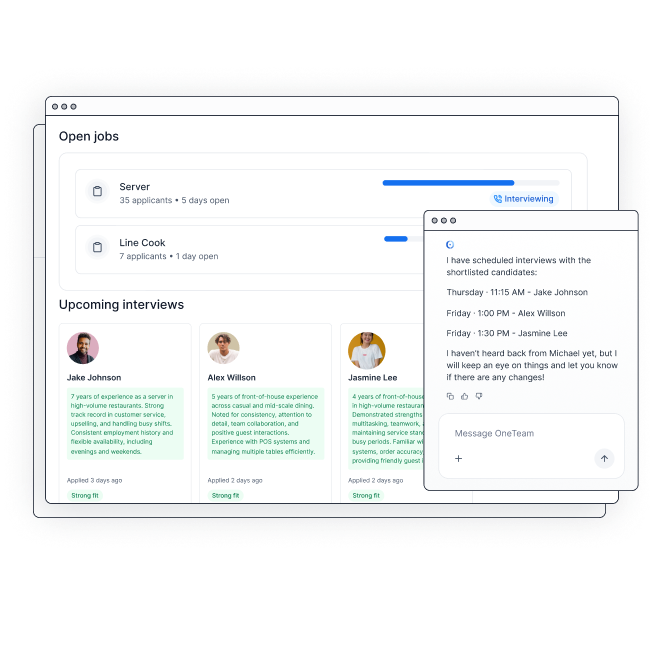
This is where tools like OneTeam start to change the day-to-day. Instead of managing every interaction, managers can rely on ai interview scheduling to handle coordination in the background.
For a busy hiring team, that shift removes friction without changing how the rest of the operation runs. It also keeps team members aligned without relying on constant communication, especially when using interview scheduling software that centralizes availability and interview times.
Make Interviews More Predictable
Manual scheduling introduces uncertainty at every step. Interview times get loosely agreed on. Confirmations are delayed. Candidates forget or lose interest. Managers assume something is locked in when it isn’t.
The result is inconsistency. When scheduling is structured, interviews become more predictable. Candidates select confirmed interview times, receive clear communication, and can adjust when needed without restarting the process.
That predictability improves follow-through. More interviews happen as planned. Fewer fall through the cracks. The hiring process becomes easier to manage because it behaves consistently.

Maintain Candidate Momentum Before It Drops Off
Candidates applying to restaurant roles move quickly. They are often evaluating multiple opportunities at once.
When scheduling slows down, interest fades. This is where restaurants lose top talent without realizing it. Not during screening, but during the gap before interviews are confirmed.
The benefits of automated interview scheduling tools become clear at this moment. Candidates can immediately select a time that works, which keeps them engaged and moving forward.
Maintaining that momentum is what allows restaurants to schedule interviews faster and stay competitive in a fast-moving hiring market.
Align Hiring Across Managers and Locations
One person rarely handles hiring. A general manager, assistant manager, and shift leads may all be involved at different stages. Without structure, coordination becomes inconsistent.
Interview times overlap. Availability gets miscommunicated. Decisions slow down because information is scattered.
Structured scheduling creates shared visibility. Availability updates in real time, and recruiters and hiring managers operate within the same system. This is where an applicant tracking system software becomes valuable. It connects scheduling with the broader recruitment process, so candidates move forward without delays between steps.
Where Tools Like OneTeam Fit Into Daily Operations
Once scheduling is automated, the entire hiring process becomes easier to manage.
Restaurants that frequently hire often move toward tools like OneTeam to reduce coordination. Instead of managing every step individually, managers rely on systems that handle scheduling in the background.
For teams that want scheduling to connect with the rest of the hiring process, ai hiring software can help manage candidate screening, communication, and interview coordination in one workflow.
With automated interview scheduling, candidates select from available time slots without waiting for a response. Interviews are confirmed immediately, and the process continues without interruption. Using interview scheduling software in this way changes how time is spent. Less effort goes into organizing interviews, and more attention goes into selecting the right candidates.
Faster Hiring Comes From Removing Delays
Speed in hiring is often treated as something that needs to be improved directly. In reality, speed improves when delays are removed. Scheduling is one of the largest sources of delay in restaurant hiring.
When that step becomes structured:
- Interviews get scheduled earlier
- More candidates make it through the process
- Decisions happen without unnecessary gaps
The benefits of automated interview scheduling tools become more visible as hiring volume increases. What once slowed the process down becomes a consistent, reliable step.
FAQ


No setup fees.
No long-term commitment.
Create your account and start hiring.
