
Last-Minute Restaurant Staffing Ideas
TL;DR
Last-minute restaurant staffing depends on how quickly you can respond when shifts need coverage. Restaurants that reduce hiring friction, organize candidates, and speed up decision-making are better equipped to handle staffing gaps without disrupting operations.

Lyuba


Last-minute restaurant staffing exposes the gap between how restaurants operate and how traditional hiring systems work. Restaurants move in real time, but hiring processes are often too slow to keep up with urgent staffing needs.
When managers are forced to hire reactively, service quality and team stability suffer. This article explores how restaurants handle short-term staffing challenges and which solutions actually help teams respond faster and operate more efficiently.
Why Speed Breaks Most Hiring Systems
Traditional hiring assumes you have time. Restaurants rarely do. The typical process looks fine on paper. Post a job, review applicants, schedule interviews, and make a hire. But in practice, every step creates a delay.
Managers lose hours reviewing resumes that don’t translate to real performance. Candidates drop off mid-process. Interviews get pushed between shifts. Meanwhile, the floor keeps moving.
The issue isn’t effort. It’s a mismatch. Hiring systems are designed for stability. Restaurant operations are built around constant change. That gap is what makes last-minute restaurant staffing so difficult to manage.
The Trade-Off Between Speed and Quality
When staffing shortages hit, managers make fast decisions. And fast decisions come with trade-offs. Bringing in temporary workers or gig workers solves the immediate problem. You get coverage. Service continues. The shift survives.
But speed often comes at the cost of consistency. A worker who doesn’t know your flow slows down the team. A mismatch in pace or communication creates friction. The experienced staff ends up compensating, which leads to burnout over time. On the other hand, waiting for the “right” hire isn’t realistic when you’re short tonight. This is the core tension:
- Move fast and risk inconsistency
- Move carefully and risk being understaffed
Strong operators don’t eliminate this trade-off. They manage it better than others.
Where Staffing Agencies and Gig Platforms Fit
Staffing agencies and gig platforms exist because restaurants need speed. Agencies provide access to pre-screened restaurant workers. That reduces some risk, especially when you need multiple roles covered or support for special events. But agencies introduce cost and dependency. You’re still waiting on someone else’s system to deliver.
Gig platforms and mobile apps shift control back to the manager. You can search for available workers, review profiles, and confirm shifts in real time. This works well for short-term gaps and flexible scheduling. For restaurants dealing with constant turnover, many operators also start looking beyond temporary coverage toward tools like AI hiring assistant that help organize direct hiring, reduce repeat staffing chaos, and make it easier to build a stronger core team instead of constantly restarting the search.
But here’s the limitation most operators notice quickly: Access doesn’t equal reliability. Just because someone is available doesn’t mean they’re the right fit for your restaurant, your pace, or your team. Over time, managers start favoring the same workers repeatedly, which defeats the purpose of an open marketplace.
The Hidden Cost of Reactive Hiring
Reactive hiring feels necessary, but it compounds problems over time. Every time a manager scrambles to fill a shift, other priorities get pushed aside. Training gets rushed. Team development stalls. Strong employees carry more weight.
This leads to a pattern:
- A staffing gap appears
- The manager reacts quickly
- The immediate problem is solved
- The underlying issue remains
Over weeks and months, this cycle drives higher turnover and weaker team cohesion. The real cost of last-minute restaurant staffing isn’t the shift you cover. It’s the long-term instability it creates if nothing changes.

What High-Performing Restaurants Do Differently
Restaurants that handle staffing well don’t rely on speed alone. They reduce how often speed is required. They do this by tightening the gap between “needing someone” and “knowing who to call.”
Instead of starting from zero every time, they maintain a live pool of candidates. Not just resumes, but real people they’ve already evaluated in some way. This changes the dynamic completely. When a shift opens up, the question isn’t “Who applied?” It becomes “Who’s already a known option?”
This is where systems like an applicant tracking system or restaurant hiring software start to matter. Not because they automate hiring, but because they organize it in a way that’s usable under pressure.
Reducing Friction Inside the Hiring Process
Most hiring delays come from friction. A few common friction points are:
- Too many resumes with too little signal
- Back-and-forth communication that goes nowhere
- Interview scheduling that drags across days
- No clear way to prioritize strong candidates
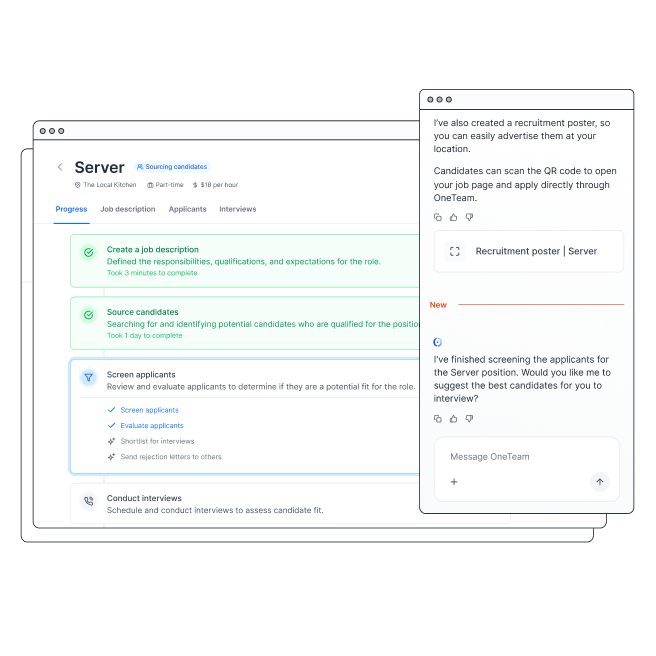
Removing friction doesn’t mean adding complexity. It means simplifying decisions. Benefits of tools like an AI hiring assistant become practical. Platforms like OneTeam don’t try to overhaul how managers think. They reduce the time it takes to move from interest to decision.
Instead of digging through applications, managers see structured candidate summaries. Instead of chasing availability, interviews get scheduled without constant follow-up. For teams already using applicant tracking software for restaurants, this isn’t a big shift. It’s a refinement. The process becomes faster without becoming heavier.
Building a System That Works During a Rush
A hiring system only works if it holds up under pressure. That means it needs to answer three questions quickly:
- Who is available right now?
- Who has already been vetted?
- Who can step in without slowing the team down?
If a system can’t answer those questions in minutes, it won’t help during service. Strong restaurant teams build lightweight systems that stay updated without constant effort. They revisit candidate pools regularly. They keep notes on past applicants. They track who performed well in short-term roles.
This turns hiring from a reactive task into an operational advantage.
Balancing Short-Term Fixes With Long-Term Stability
Short-term solutions will always be part of the restaurant industry. There will always be call-outs, unexpected rushes, and scheduling gaps. Temporary workers and gig platforms will always have a place.
But relying on them too heavily creates instability. The goal isn’t to eliminate last-minute restaurant staffing. It’s to reduce how often it disrupts your operation.
That balance usually looks like this:
- Use short-term help for flexibility
- Maintain a ready pool of known candidates
- Invest in hiring systems that reduce decision time
- Focus long-term hiring on building a stable core team
When these pieces work together, staffing stops feeling like a constant emergency.
FAQ


No setup fees.
No long-term commitment.
Create your account and start hiring.
