
How to Improve Your Restaurant Hiring Process Fast
TL;DR
Restaurant hiring often breaks down because of slow responses, interview bottlenecks, no-shows, and inconsistent systems. Restaurants that speed up screening, scheduling, and onboarding can often reduce time-to-hire dramatically and improve long-term retention.

Lyuba


Restaurant hiring moves fast. A strong candidate can apply, interview elsewhere, and accept another offer within hours, not days. For many restaurants, the biggest hiring problem is not attracting applicants. It is the friction that happens after they apply, including slow follow-ups, delayed scheduling, resume backlogs, and too many manual steps.
These delays create immediate operational pressure. Staffing gaps increase burnout, managers lose floor time reviewing applications, and existing employees absorb more workload. Improving your restaurant hiring process does not require rebuilding everything. Small changes like faster screening, quicker interview scheduling, and more structured communication can significantly reduce time-to-hire while helping protect service quality and retention.
Where Restaurant Hiring Actually Loses Good Candidates
Restaurants rarely lose candidates because of one disaster. They lose them through slow leaks. They usually come from small breakdowns at multiple stages of the process, each adding enough friction to push qualified candidates elsewhere. In restaurants, losing speed often happens in predictable places:
Application stage:
- Applications sit too long before review
- Managers are too busy to respond quickly
- No immediate screening system exists
Interview stage:
- Scheduling takes too long
- Candidates lose interest
- No-shows increase when communication is weak
Decision stage:
- Too many approval steps
- Delayed offers
- Managers restart the search after losing momentum
Why this matters
Restaurant candidates usually make decisions quickly, especially for hourly roles. A process that feels slow, unclear, or disorganized can signal operational chaos before a candidate ever steps on the floor. For many job seekers, slow hiring can suggest:
- Poor management structure
- Scheduling inconsistency
- Weak communication
- Delayed onboarding
That perception alone can make sourcing candidates a lot more taxing and difficult.
The biggest breakdown is often process ownership
The biggest breakdown is often process ownership. Knowing where to hire restaurant staff matters, but candidate volume means little if managers cannot respond, screen, or schedule fast enough to convert strong applicants
- First response speed
- Screening consistency
- Interview scheduling
- Offer timing
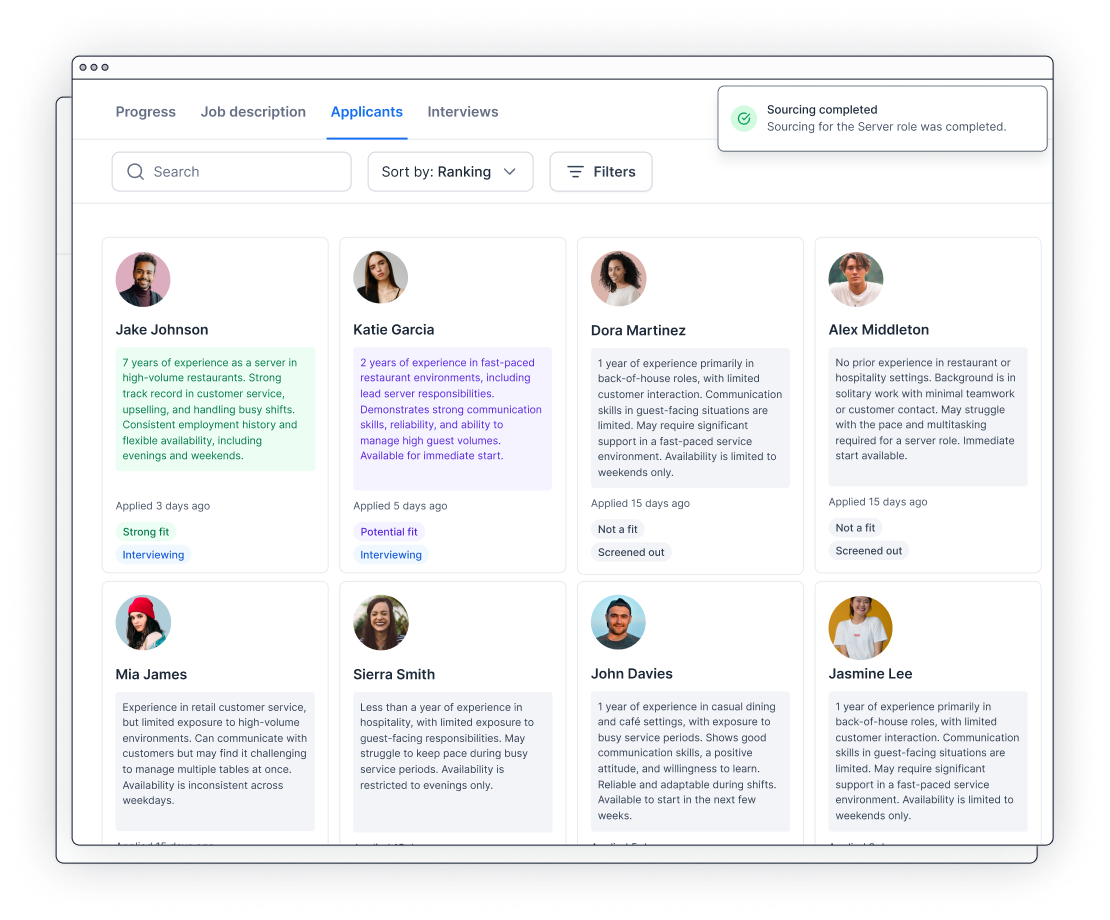
This is where tools like OneTeam AI Hiring Assistant become relevant. As an AI Recruiting Assistant built for restaurant hiring, it can help operators tighten screening, speed up coordination, and create more consistent hiring ownership before strong candidates drop off.
How to Speed Up Your Restaurant Hiring Process Without Lowering Standards
Speed matters, but speed without structure creates expensive mistakes. One of the biggest misconceptions in restaurant hiring is that speed and quality work against each other. In reality, slow hiring often creates worse outcomes because strong candidates drop off while weaker fits stay available longer.
The goal is not to rush decisions. It is removing unnecessary delays between each step.

Step 1: Reduce screening bottlenecks immediately
Many restaurant managers lose valuable time sorting through every application manually, often between shifts or after service. This creates a resume backlog fast.
Instead, hiring speed improves when restaurants focus first on quickly identifying who is worth immediate follow-up.
Prioritize:
- Fast first-response time
- Clear knockout criteria for basic role fit
- Same-day applicant review when possible
- Faster communication with qualified candidates
This is where many restaurants begin using Automated candidate screening or structured workflows to reduce manual review time without sacrificing quality. For operators balancing multiple openings, tools like OneTeam can help move qualified applicants forward faster while cutting down on repetitive screening work.
Step 2: Compress interview scheduling
Interview delays are one of the biggest time-to-hire killers in restaurants. Every extra day between screening and scheduling increases the chance of candidate drop-off.
Hiring speed improves when restaurants:
- Offer same-day or next-day interview slots
- Reduce back-and-forth scheduling
- Keep interview steps simple
- Confirm interviews quickly to reduce no-shows
For hourly restaurant jobs, long interview pipelines often create more friction than better hiring decisions.
Step 3: Simplify decision-making
Many restaurants lose candidates after strong interviews simply because decision timelines drag.
Common delays include:
- Waiting for multiple manager approvals
- Unclear hiring authority
- Slow offer communication
- Delayed onboarding preparation
The fastest-moving restaurants usually hire well because they define decision ownership early and reduce unnecessary approval bottlenecks.
What faster hiring actually looks like
Better process:
- Apply
- Screen quickly
- Schedule within 24 hours
- Interview
- Decide fast
Slower process:
- Apply
- Wait days
- Delayed outreach
- Scheduling confusion
- Candidate disappears
Improving your restaurant hiring process fast is often less about adding more candidates and more about protecting momentum. Restaurants that tighten screening, scheduling, and decision speed often improve both hiring quality and retention because stronger candidates experience a process that feels organized, responsive, and operationally stable.
Turn Faster Hiring Into a Repeatable 48-Hour System
Once restaurants fix slow screening and interview delays, the next step is creating a hiring process that consistently moves fast under pressure. Speed matters most when it becomes repeatable.
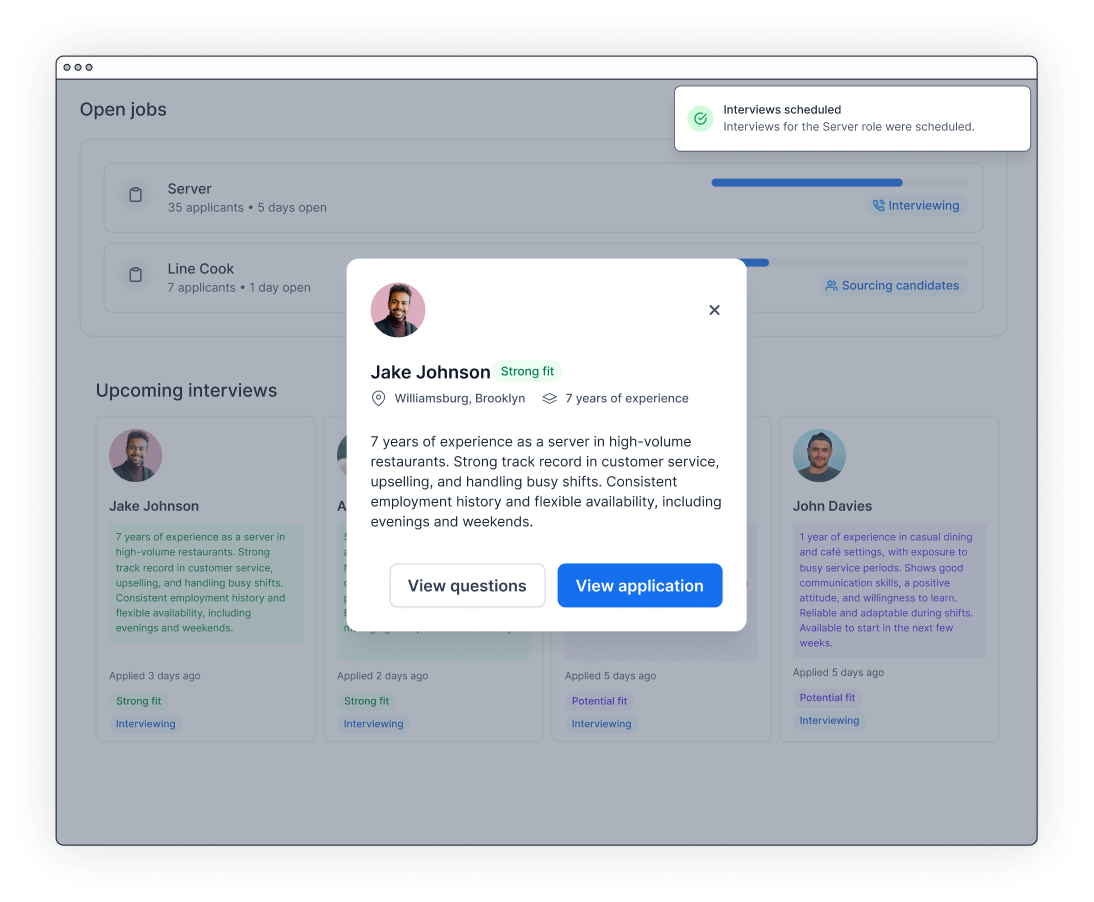
For many operators, hiring slows down not because they lack urgency, but because every opening feels like starting from scratch. This is where an Applicant tracking system can help create a repeatable structure by organizing hiring steps, centralizing candidate progress, and reducing avoidable delays.
Day 1: Application to screening
The first day should focus on speed, visibility, and immediate movement.
Priorities:
- Review applicants quickly
- Identify basic role fit
- Respond to qualified candidates fast
- Schedule interviews immediately
This stage is often where restaurants either build momentum or lose it. Waiting too long at this point can shrink the candidate pool before interviews even begin.
Day 2: Interview and decision
For most hourly restaurant roles, long interview pipelines often create unnecessary friction. The goal is to confirm fit, reliability, and availability without overcomplicating the process.
Focus on:
- Same-day or next-day interviews
- Clear role expectations
- Availability confirmation
- Cultural fit and customer service readiness
- Fast hiring decisions
Day 3: Offer and onboarding prep
Hiring speed means little if post-offer delays create a drop-off.
Key actions:
- Extend offers quickly
- Confirm start dates
- Begin the onboarding process immediately
- Share scheduling expectations early
- Keep communication active until the first shift
This is where many restaurants lose candidates they have already chosen. Application tracking software can help prevent these drop-offs by organizing offer communication, onboarding steps, and first-shift coordination so new hires do not disappear between acceptance and day one.
Why this process matters
A 48-hour hiring system does more than fill roles faster. It helps restaurants:
- Reduce candidate drop-off
- Lower manager stress
- Improve process consistency
- Strengthen employer brand
- Protect existing team members from prolonged understaffing
A stronger process creates a system that managers can repeat, whether they are replacing one server or hiring an entire shift team.
How Better Hiring Processes Improve Retention Before Day One
Hiring speed solves one problem, but hiring process quality usually determines whether new team members actually stay. For many restaurants, turnover does not just come from poor candidate fit. It often starts when the hiring and onboarding process feels disorganized before a new hire ever works their first shift.
This stage gets overlooked in many restaurant hiring systems. A slow or chaotic process does not just lose candidates during recruitment. It can also weaken retention after the hire.
Early hiring experiences shape long-term perception
From the candidate’s perspective, the hiring process often becomes their first real look at how restaurant management operates.
When the process feels:
- Slow
- Disorganized
- Unclear
- Difficult to schedule
- Poorly communicated
It can signal deeper operational problems before someone even joins your team.
For restaurants hiring frequently, this matters because strong candidates are often evaluating more than pay. They are also assessing whether the workplace feels stable enough to join long-term.
Hiring process consistency can improve retention rate
Restaurants that move quickly while staying organized often create stronger early impressions.
That may include:
- Fast interview scheduling
- Clear first-shift expectations
- Reliable communication
- Structured onboarding process
- Better role clarity
These small process improvements can help reduce ghosting, improve show-up rates, and create a stronger cultural fit from the start.
Retention often starts before onboarding
Many operators think retention begins after training, but in reality, it often begins the moment candidates enter the hiring process.
A smoother system can help restaurants:
- Reduce first-shift no-shows
- Improve candidate confidence
- Strengthen employer brand
- Increase long-term team stability
- Reduce repeat hiring pressure
For operators balancing multiple locations or frequent openings, this is where process structure can create larger long-term advantages. OneTeam's AI Hiring Assistant can help support more consistent hiring coordination, faster communication, and smoother transitions from candidate screening to onboarding without adding more manual pressure to restaurant management teams.
Fast Restaurant Hiring Is About Process, Not Panic
Restaurant hiring often feels urgent because it usually is. Open roles affect service quickly, burnout builds fast, and managers rarely have the luxury of moving slowly. But the restaurants that improve hiring fastest are not always the ones scrambling hardest. They are usually the ones with better systems.
The biggest hiring gains usually come from reducing friction where it matters most:
- Faster response times
- Quicker screening
- Same-day or next-day interview scheduling
- Clear hiring ownership
- Stronger onboarding follow-through
For restaurants trying to improve each of these steps without adding more manual work, ai hiring software can help create a faster, more consistent process from application to first shift. When these systems improve, restaurants often hire faster without lowering standards, reduce no-shows, and create a more stable path from application to first shift.
FAQ


No setup fees.
No long-term commitment.
Create your account and start hiring.
