
Your Step-by-Step Guide to Hiring Restaurant Staff in a Competitive Market
TL;DR
Hiring restaurant staff in a competitive market requires more than posting a job and hoping the right person applies. This guide walks through a six-step process for defining the role, posting effectively, screening fast, interviewing well, moving quickly, and building retention into the hiring process from day one. Restaurants that follow a repeatable system fill roles faster and keep them filled longer.

Helgi
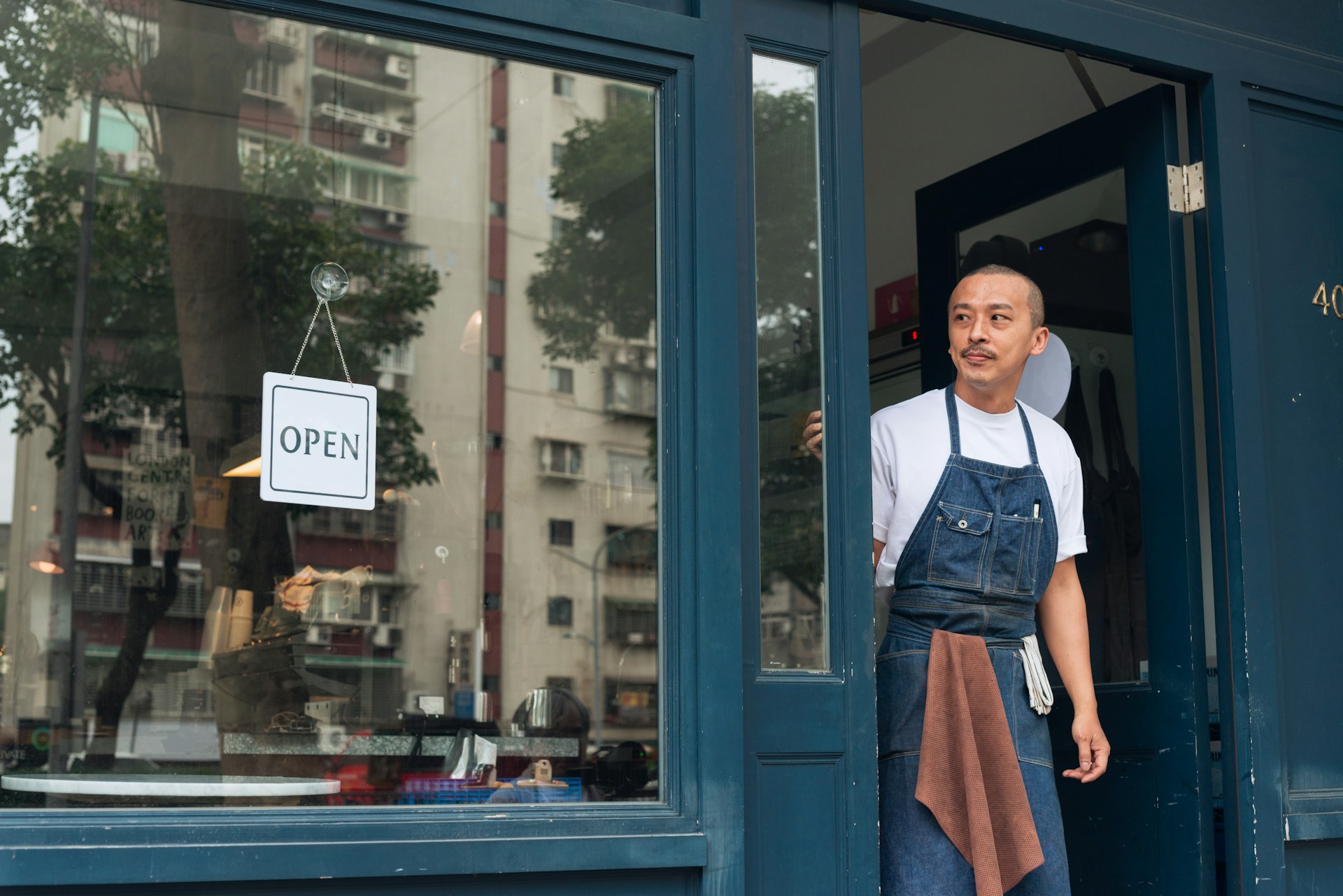


Restaurant turnover is expensive, but the biggest cost is the process that keeps it going. Every reactive hire, every scrambled posting, every no-show interview is a symptom of the same underlying problem: there is no system.
Hiring without a system was always costly. In this market, it is disqualifying. The restaurant staffing shortage has tightened the labor pool, raised candidate expectations, and shortened the window between application and offer. Restaurants without a clear process lose qualified candidates to operators who move faster and decide with more confidence. This guide covers the six steps that separate restaurants stuck in a constant hiring cycle from those that fill roles fast, keep good people longer, and stop treating every vacancy as an emergency.
Step 1: Define Exactly Who You Need to Hire
Most bad hires start before the interview. They start with a vague job posting that attracts the wrong candidates, sets unclear expectations, and creates misalignment that shows up on the floor within the first two weeks. Getting specific before posting is what separates intentional hiring from reactive hiring.
Identify the Role Requirements
Every position on the floor has different demands and attracts different candidates. Understanding the full range of positions in restaurant staff before posting helps operators get specific about what each role actually requires. Most hiring mistakes are traceable back to this step. A role that is not clearly defined before posting cannot be clearly evaluated during screening, and it cannot be fairly judged during the first two weeks on the floor.
Create a Job Description That Attracts the Right Candidates
A job description that lists duties without context attracts candidates who do not fully understand what they are walking into. The strongest job descriptions explain what the role actually involves day-to-day, what the shift requirements are, what experience is needed versus preferred, and what growth looks like within the operation. Restaurants that use an ai job description generator to build these postings get specific faster without pulling a manager off the floor to write from scratch every time a role opens.
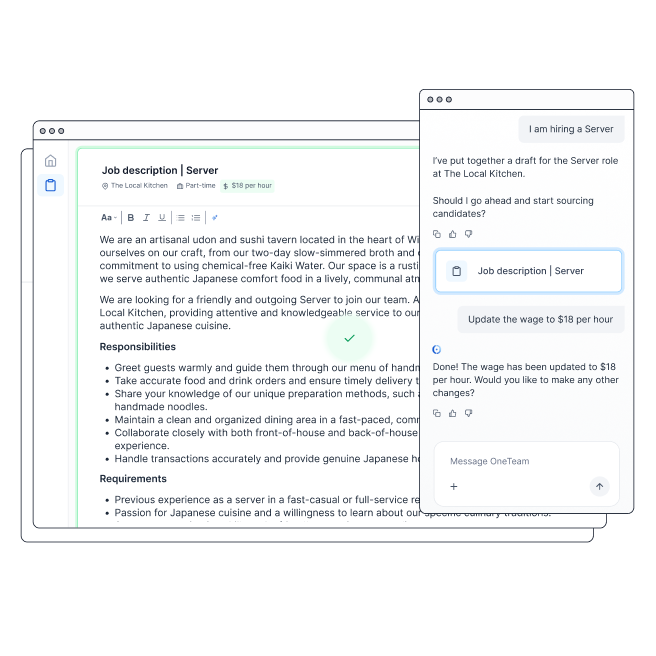
Clear expectations filter out poor fits before the interview stage. They also signal to strong candidates that the restaurant takes hiring seriously, which matters more than most operators realize when competing for quality applicants in a tight market.
Step 2: Post Your Job Where Restaurant Workers Are Looking
Effective posting for hiring restaurant staff means reaching candidates on the platforms they actually use. That includes restaurant-specific job boards, general platforms with strong hospitality categories, and social channels where local candidates are active. The faster a posting goes live after a vacancy opens, the better the chances of catching candidates who are actively looking right now.
For managers juggling multiple locations, a restaurant staffing guide is worth reviewing before committing to a platform. The context of how staffing strategy works across locations makes the tool choice easier.
Step 3: Screen Candidates Quickly Without Sacrificing Quality
High application volume is a different problem than it sounds. More applicants do not mean better candidates, and spending hours reviewing every submission manually is time most restaurant managers do not have between shifts. The goal is not to read every resume. It is to identify the strongest candidates fast enough to act on them before they accept something else.
A restaurant applicant tracking system organizes incoming applications by role and location, keeps every candidate visible across the hiring process, and prevents strong candidates from getting lost when one manager is busy and another needs to pick up where they left off.
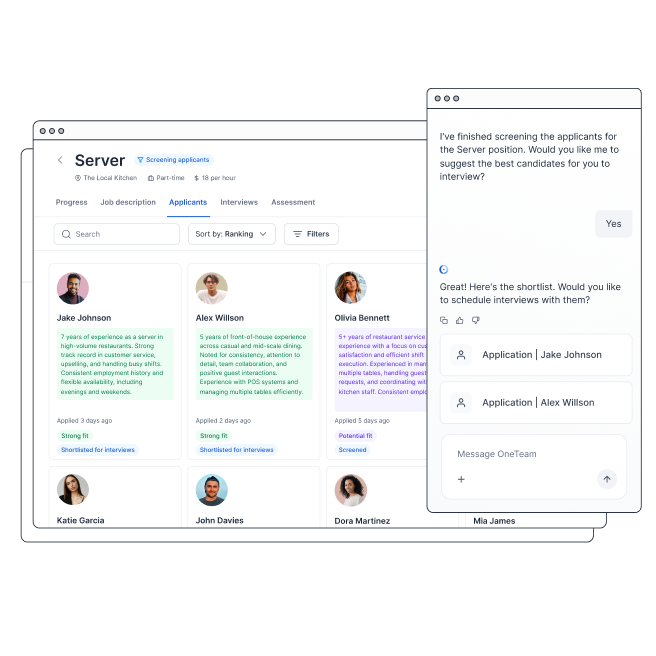
For restaurants hiring at volume, that sorting problem compounds fast. Instead of manually reviewing every application, OneTeam automatically screens applicants and highlights the strongest candidates first, so managers spend time evaluating people rather than sorting through a pile.
Step 4: Conduct Better Restaurant Interviews
The interview for a restaurant role should test what the job actually demands. For front-of-house positions, that means testing composure, communication, and how a candidate handles pressure. For back-of-house roles, it means understanding their pace, their experience with high-volume service, and how they operate when the kitchen gets loud and the tickets back up.
The strongest interview questions for restaurant staff are situational. They ask candidates to describe what they have already done, not what they would do in a hypothetical. A candidate who can talk clearly and specifically about how they handled a difficult table, a short-staffed shift, or a kitchen breakdown is far more reliable than one who gives a polished answer to a theoretical question.
Using AI for restaurant hiring to prepare consistent interview questions across locations means every candidate gets evaluated against the same standard, regardless of which manager is conducting the interview that day.
Step 5: Move Fast Before Candidates Accept Another Offer
Speed is one of the most underrated parts of how to hire restaurant staff well. The best candidates in a competitive market are interviewing at multiple places at once. Restaurants that take a week to follow up, three more days to schedule an interview, and another two days to make a decision lose good people to operators who move in 24 to 48 hours.
The gap between application and offer is where most restaurant hiring falls apart. Interview scheduling software removes the back and forth that slows this stage down the most. It sends interview invites, offers available time slots, handles confirmations, and delivers reminders before the interview without the manager touching any of it. Faster scheduling keeps qualified candidates in the process long enough to actually show up.
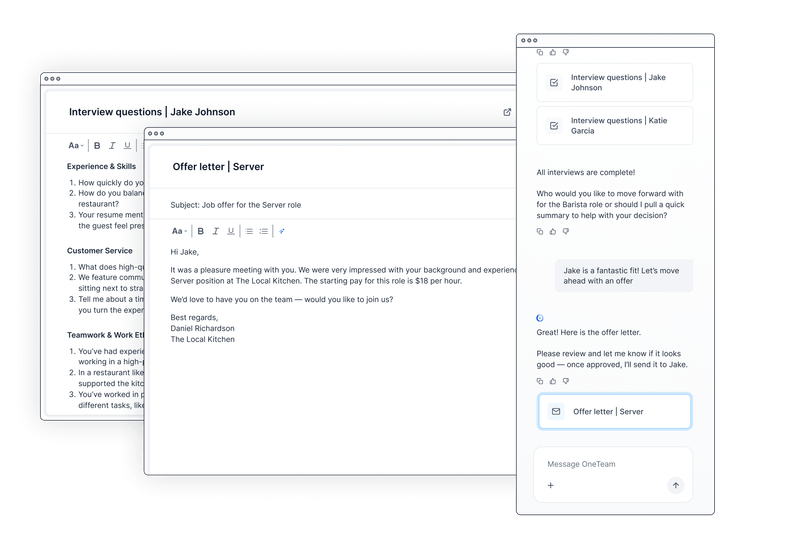
The stakes are higher than most managers account for. Managers dealing with last-minute restaurant staffing gaps know that a slow process does not just lose candidates. It leaves the floor short during service, and that cost shows up immediately.
Step 6: Focus on Retention, Not Just Hiring
Hiring the right person is only half the job. Restaurants with high restaurant staff turnover often focus entirely on filling the role and nothing on what happens after the hire. The first two weeks on the floor are when most new restaurant employees decide whether they are staying or looking for something else.
Structured onboarding, clear expectations from day one, consistent scheduling, and regular feedback in the first thirty days reduce the early turnover that forces the hiring process to start over. Retention does not require a formal program. It requires managers who set expectations clearly, follow through consistently, and give new restaurant employees a reason to stay past the probationary period.
Build a Restaurant Hiring System Instead of Starting Over Every Time
The restaurants that handle turnover most effectively are not the ones that hire the fastest in a crisis. They are the ones with a system already running before the crisis hits. Managers who want a practical starting point should look at how to improve their restaurant hiring process before the next vacancy opens.
A repeatable hiring process means job descriptions are ready before a role opens, posting goes live the same day a vacancy appears, screening happens automatically, and interviews get scheduled without back-and-forth coordination. It also means building a candidate pipeline, keeping past applicants organized, and reusing the interview structures and job descriptions that have worked before instead of rebuilding them every time. OneTeam is the AI hiring assistant for restaurants that turns that kind of repeatable system into something managers can actually rely on between shifts.
For restaurants that want to connect those steps in one workflow, ai hiring software can help manage job descriptions, screening, interview scheduling, and candidate communication without adding more manual work.
FAQ


No setup fees.
No long-term commitment.
Create your account and start hiring.
