
The Complete Guide to Hiring, Managing, and Retaining Staff
TL;DR
Restaurant staffing isn’t just about filling open roles. It’s a constant process that includes hiring, screening, scheduling, and retaining staff while running a busy floor. Most managers struggle because hiring is reactive, time-consuming, and full of no-shows. The restaurants that stay fully staffed treat hiring as an ongoing system, not a last-minute scramble. With the right approach and simple tools, managers can reduce turnover, hire faster, and spend less time buried in resumes.

Lyuba



Restaurant staffing tends to follow a pattern that feels manageable in the moment but breaks down over time. Hiring is rarely built into the way the operation runs. It gets pushed to the side, picked up when needed, and handled alongside everything else competing for attention.
On the surface, roles get filled, and shifts get covered. Underneath, the process stays inconsistent. That inconsistency shows up in how decisions are made. The time to evaluate candidates is limited. Standards shift depending on urgency. What should be a structured process becomes compressed and uneven.
This is why staffing remains unstable, even in restaurants that are constantly hiring. The issue isn’t a lack of effort or candidates. It’s that hiring is happening inside a system that wasn’t designed to support it.
This article looks at restaurant staffing from an operational perspective, how it actually functions, where it breaks down, and what changes when hiring becomes structured and continuous.
Why Restaurant Staffing Is So Hard
Restaurant staffing fails in the gap between intention and reality. Most managers understand what good hiring looks like. The problem is that they rarely get the conditions to actually do it.
A typical week doesn’t leave room for structured hiring. Service takes priority, and rightfully so. But that means hiring is pushed into whatever time is left over, which is usually fragmented and inconsistent.
Over time, this creates a slow, uneven hiring process that can’t keep up with the pace of the restaurant. Candidates drop off, roles stay open longer than expected, and the team absorbs the pressure. What looks like a hiring issue is really a breakdown in how time is allocated.
Restaurant Staffing Is More Than Hiring
Restaurant staffing is not just hiring. It’s the full process that happens before and after the hire, from sourcing candidates to keeping people on the team.
It includes:
- Finding candidates
- Screening them
- Scheduling interviews
- Making hiring decisions
- Retaining staff
Most restaurants only focus on one part at a time, usually when something breaks. But staffing only works when all of these pieces run together. If one step slows down, the entire process backs up. That’s why improving just one part of hiring rarely fixes the problem.
How to Plan Your Restaurant Staffing Needs
Restaurants often begin hiring without a clear picture of what they actually need. Roles are defined too broadly, schedules aren’t mapped out, and expectations shift after someone is hired. That’s what leads to mismatches and early turnover.
Planning staffing properly means stepping back before posting a job and looking at how the restaurant actually runs week to week. At a minimum, managers should think through:
- Shift coverage requirements: Which days and hours are consistently understaffed?
- Role-specific needs: Do you need speed, experience, or flexibility?
- Full-time vs part-time balance: Over-relying on either creates scheduling problems later
- Peak vs slow periods: Staffing for weekends looks different than weekdays
When this step is skipped, hiring becomes reactive by default. When it’s done well, everything downstream moves faster and with fewer mistakes.
Front-of-House vs Back-of-House Hiring
The pressure of restaurant staffing shows up differently depending on the role, but the core issue stays the same. Managers need to make fast decisions with limited time.
Front-of-House
Front-of-house roles generate volume, but volume doesn’t solve the problem. You still need to figure out quickly who can:
- Handle a rush
- Communicate with guests
- Show up consistently
That’s hard to assess through resumes alone, especially when you’re short on time.
Back-of-House
Back-of-house hiring is tighter and more immediate. You’re dealing with:
- A smaller candidate pool
- Higher pressure during service
- Less room for error
Here, priorities are clear:
- Reliability comes first
- Experience matters
- Consistency is everything
Why Restaurant Staffing Keeps Breaking Down
The instability in restaurant staffing is not caused by a single issue. It is the result of several pressures that build on each other over time.
1. High turnover keeps hiring constantly in motion
Even strong teams lose people regularly, which means the process never really resets. Without structure, each departure forces managers back into reactive mode.
At the same time, hiring usually starts too late. By the time a role is posted, the gap has already hit the schedule. That delay shortens the time available to evaluate candidates and increases the pressure to hire quickly instead of correctly.
2. Application volume adds another layer of friction
Job boards bring in visibility, but they also create a backlog. Managers are left sorting through candidates manually, which slows things down or leads to rushed decisions.
3. Interview scheduling creates further delays
What should be simple often turns into back-and-forth messaging that stretches over days, increasing the chances of candidate drop-off.
These pressures tend to show up in the same ways:
- Hiring never fully stops, so managers rarely get ahead
- Roles open before hiring begins, putting immediate pressure on the team
- More applications create more work, not better outcomes
- Delays in scheduling cost strong candidates
All of this plays out in an environment where managers are already stretched thin. Hiring competes with daily operations, and most of the time, it gets pushed until it becomes urgent.
What Slows Down Restaurant Hiring the Most
Most hiring delays don’t come from a lack of applicants. They come from how the process is handled day to day.
Small delays at each stage add up quickly. A day to review resumes. Another day to respond. A few more to schedule interviews. By then, strong candidates are already gone. The most common bottlenecks are:
- Manual resume review
- Delayed responses to candidates
- Interview scheduling gaps
- No clear hiring workflow
These slowdowns don’t feel significant on their own. But together, they create a process that can’t keep up with the pace of the restaurant.
Different Ways to Staff a Restaurant
Restaurants rely on different staffing solutions depending on urgency and resources. Each option solves one problem but creates another.
Most restaurants end up combining these approaches, but without structure, the outcome stays inconsistent.
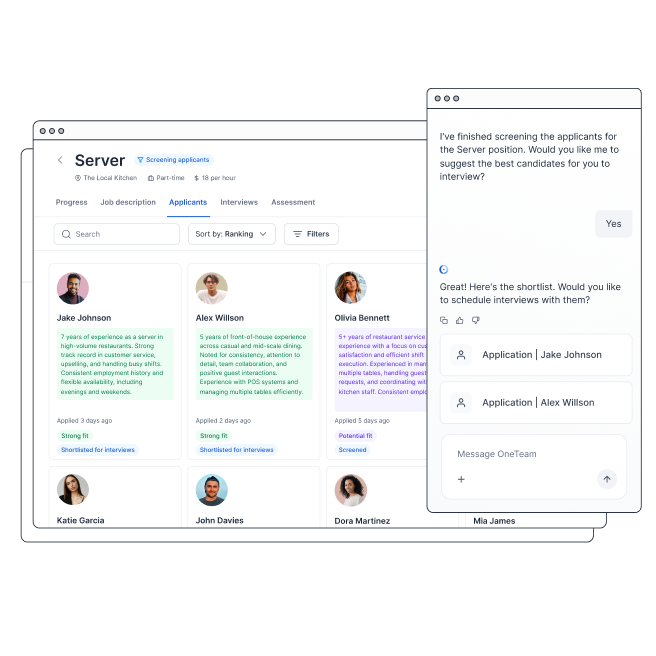
More recently, some restaurants have started shifting away from fully manual hiring. Instead of reviewing every resume and coordinating interviews themselves, they use tools like OneTeam to handle the early stages of hiring. Managers don’t have to organize everything manually, which makes it easier to move faster without lowering standards.
How Much Does Restaurant Staffing Cost?
The real cost of restaurant staffing goes beyond hourly wages and shows up in time, turnover, and how often you have to repeat the hiring process.
Hiring in-house may seem cheaper, but it comes with hidden costs. Managers spend hours reviewing resumes, scheduling interviews, and following up with candidates. That time usually comes at the expense of running the floor.
Staffing services solve speed but increase cost. You pay a premium for quick placements, and there’s often less control over long-term fit. If the hire doesn’t last, you’re back where you started.
The real cost of restaurant staffing often comes down to three things:
- Time spent managing hiring
- Turnover from rushed decisions
- Lost productivity from understaffed shifts
When hiring becomes faster and more consistent, those costs start to drop.
Where Restaurants Actually Find Staff Today
Most restaurants in the hospitality industry don’t rely on a single hiring channel, especially in fast-moving food service environments where hiring needs change week to week.
- Job boards
- Employee referrals
- Walk-ins
- Social media
The challenge isn’t access to candidates. It’s managing the volume and identifying who is actually worth moving forward. Restaurants that improve restaurant staffing don’t just add more channels. They make it easier to sort, screen, and act on the candidates they already have. This why ai candidate screening software was created.
How to Hire Restaurant Staff More Effectively
Most restaurants follow the same hiring steps. The difference is how efficiently those steps move. The strongest processes remove delays at each stage.
- Define the role clearly: Clear expectations reduce unqualified applications and save time later.
- Source candidates consistently: Hiring should not start from zero every time a role opens.
- Screen faster: Reviewing every application manually slows everything down. AI hiring software helps filter candidates early so managers can focus on the people most likely to succeed in the role.
- Schedule interviews quickly: Speed matters. Delays here cost you candidates. Automated interview scheduling helps keep the process moving without the back-and-forth that slows hiring down.
- Make decisions without delay: Strong candidates don’t stay available for long.
Small improvements at each step add up to a much faster and more reliable hiring process. This is where most operators start when they want to improve their restaurant hiring process without adding more work to an already busy schedule.
How to Evaluate Restaurant Candidates Quickly
One of the hardest parts of restaurant hiring is not finding candidates. It’s deciding who is actually worth hiring in a short amount of time. Most managers rely on instinct because they don’t have time to evaluate candidates deeply. But without a clear way to assess people quickly, hiring becomes inconsistent.
Strong operators look for a few signals that matter more than resumes:
- Reliability signals
- Availability fit
- Relevant experience under pressure
- Attitude during interaction
The goal isn’t to over-analyze. It’s to filter quickly and consistently, so decisions don’t rely entirely on gut feeling. When evaluation becomes clearer, hiring becomes faster and more repeatable.
Why Retention Is Part of Restaurant Staffing
Staffing doesn’t end when someone is hired. In most cases, that’s where the real work begins. Every early exit resets the hiring process. That means more time spent sourcing, screening, and interviewing just to get back to where you started.
Retention is what stabilizes restaurant staffing over time. Without it, even fast hiring processes will struggle to keep up. In practice, retention comes down to a few consistent factors:
- Clear expectations from the start
- Predictable schedules
- A team environment that people want to stay in
When those are in place, turnover slows down. And when turnover slows down, staffing becomes easier to manage.
From Reactive to Continuous Hiring
Reactive hiring creates pressure. Every open role feels urgent, and urgency leads to rushed decisions. Continuous hiring removes that pressure. Instead of restarting every time, you:
- Keep a steady flow of candidates
- Revisit strong past applicants
- Move faster when roles open
Hiring becomes part of your operation, not a disruption to it.
How Technology Is Changing Restaurant Staffing
Traditional hiring methods rely heavily on manual effort, which slows everything down and creates unnecessary delays at every stage.
Modern approaches focus on reducing that workload so managers can move faster without adding more complexity to their day. This shift is where AI recruiting software is starting to change how restaurants approach hiring.
Instead of spending hours reviewing resumes and coordinating interviews, managers can rely on structured candidate screening and faster scheduling. The result is a process that moves at the same pace as the restaurant, not behind it.

What Features to Look for in Restaurant Staffing Software
Most managers are not looking for more features. They are looking for fewer steps. When evaluating tools, the real question isn’t what a system can do.
It’s whether it actually makes hiring easier during a busy shift. That’s where understanding the right features in restaurant staffing software becomes important. In practice, the best tools all do a few things well.
- Easy to use without training
- Works on mobile
- Saves time immediately
Strong tools also reduce the manual parts of hiring. They help with sourcing candidates, filtering applicants, and coordinating interviews without constant back-and-forth. That’s what actually removes friction from the process.
At the same time, simplicity matters more than capability. If a tool introduces extra steps or feels complicated, it won’t get used when things get busy. And if it doesn’t get used consistently, it doesn’t solve the problem.
Restaurant Staffing Is an Operational Problem, Not a Hiring Problem
Most restaurants don’t struggle to find people. They struggle to create the conditions where hiring can actually work.
When hiring is pushed to the edges of the day, decisions get compressed. Time to evaluate disappears. Conversations get rushed. What should be a deliberate process turns into a series of quick fixes tied to the schedule.
That pattern is what keeps staffing unstable. Not a lack of candidates, but a system that forces hiring to happen under pressure, over and over again.
The shift happens when hiring is no longer treated as a separate task. When it runs alongside operations, when manual steps are reduced, and when managers can move quickly without cutting corners, the process starts to hold.
That’s when restaurant staffing stops feeling like a constant problem and starts becoming something you can actually control.
FAQ


No setup fees.
No long-term commitment.
Create your account and start hiring.
