
Why Traditional Restaurant Hiring Is Slowing You Down
TL;DR
Traditional restaurant hiring slows down because it relies on manual processes that no longer match today's labor market. Restaurants that reduce hiring bottlenecks through candidate sourcing, organized applicant tracking, and automation can shorten time to hire and reach qualified candidates faster. The result is less time managing recruitment and more time on the floor where it matters.

Helgi



Many restaurant hiring processes were built for a labor market that no longer exists. Posting a job, waiting for applications, reviewing resumes manually, and coordinating interviews one candidate at a time may have worked when qualified applicants were easier to find. Today, those same steps leave positions open longer than any manager can afford.
The result is a slow hiring process that affects far more than recruiting. Open roles increase pressure on existing teams, stretch managers across competing priorities, and make it harder to maintain service standards. Understanding where those delays occur is the first step toward building a faster, more reliable hiring process.
Why Does Traditional Restaurant Hiring Take So Long?
Restaurant hiring is rarely slowed by one major obstacle. More often, it is the result of dozens of small delays spread across the hiring process. Managers write job descriptions between shifts, review applications after service, coordinate interviews by text, and wait for responses before making a hiring decision. Each step depends on manual effort, and every delay extends the time to hire. Restaurants using an AI job description generator remove the first bottleneck before the process even starts.
Unlike larger organizations with dedicated recruiters, restaurant hiring managers are also responsible for scheduling staff, resolving guest issues, managing inventory, and leading service. Hiring becomes another responsibility competing for a limited time rather than a dedicated business function. Managers dealing with last-minute restaurant staffing gaps know exactly how fast that pressure compounds when a role stays open longer than it should.
Where Does Traditional Restaurant Hiring Create Bottlenecks?
Most restaurants experience delays at the same stages of the hiring process.
Individually, these delays may seem minor. Combined, they create a hiring timeline that can stretch for weeks.
What Is the Real Cost of a Slow Restaurant Hiring Process?
Every extra day a position remains vacant creates operational pressure. Existing employees work additional shifts, overtime increases, and managers spend more time filling gaps instead of leading their teams. Over time, those pressures contribute to burnout, inconsistent service, and higher restaurant staff turnover, which compound the problem further. Reactive hiring carries a hidden cost that shows up not just in time-to-fill, but in the quality of every hire made under pressure.
There is also a competitive cost. Qualified candidates rarely interview with just one restaurant. While one operator is still reviewing applications or completing reference checks, another may already be scheduling interviews or extending an offer. A slow hiring process often means losing strong candidates before the hiring team has made a final decision. Managers who want to reduce that competitive gap should understand the advantages of applicant tracking systems before the next vacancy opens.
Why Are Job Boards No Longer Enough for Restaurant Hiring?
Job boards remain an important part of restaurant recruiting, but they are no longer enough on their own. Traditional recruiting depends on qualified candidates finding a posting, applying quickly, and waiting for a response. In a competitive labor market, that process leaves too much to chance.
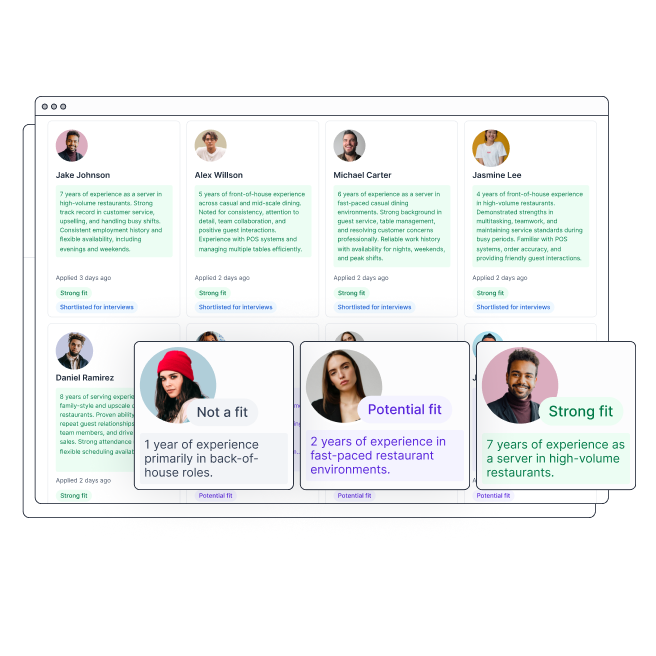
Restaurants that consistently hire well take a broader approach. They combine job postings with ongoing outreach and candidate sourcing software to reach candidates beyond those actively searching that day. Managers who want to understand how to source candidates for their restaurant should not wait until a vacancy opens to start.
How Can AI Candidate Sourcing Fix Slow Restaurant Hiring?
One of the biggest limitations of traditional hiring is waiting for qualified candidates to apply. Candidate sourcing changes by identifying and engaging potential hires before managers need to fill an immediate opening.
AI candidate screening means managers begin with candidates who already match the role's experience, availability, and location requirements rather than sorting through dozens of resumes hoping to find a good fit, which leads to more reliable hiring decisions without adding more steps to the process.
This is where OneTeam fits into the process. Rather than asking managers to learn another complicated system, OneTeam helps automate the repetitive work that slows hiring down. Candidate sourcing identifies stronger applicants earlier, while restaurant applicant tracking software keeps every application, interview, and communication organized in one place. The result extends beyond faster recruiting. Managers who want a complete picture of restaurant staffing from sourcing candidates to keeping people on the team will find that a faster hiring process is only one part of a stronger overall system.
What Does a Modern Restaurant Hiring Process Look Like?
Restaurants that consistently hire well are not necessarily attracting more applicants. They have removed unnecessary delays from their hiring process.
The goal is not simply to hire faster. It is to remove the manual work that prevents managers from making timely hiring decisions.
The Restaurants That Hire Best Build Better Systems
Hiring outcomes rarely improve because managers work harder. They improve because the hiring process becomes more consistent. Restaurants that reduce manual work, remove bottlenecks, and build repeatable hiring systems are better positioned to build a more reliable path to filling roles without restarting recruitment every time someone leaves.

Restaurant teams that make this shift do not have to rebuild their process from scratch. OneTeam is an AI hiring assistant for restaurants designed to remove the manual work slowing managers down, so they can spend more time on the floor and less time sorting through applications.
FAQ


No setup fees.
No long-term commitment.
Create your account and start hiring.
