
General Manager Job Description Duties and Hiring Tips
TL;DR / Summary
The general manager is responsible for overseeing daily operations, managing budgets, leading staff, and keeping the restaurant running at a consistent standard. This guide covers the core duties, responsibilities, and hiring tips operators need to fill the role correctly the first time.

Helgi



The general manager's job description is the most important posting a restaurant will write. Every other hire flows through or reports to this person. When the GM role is filled correctly, the restaurant runs. When it is not, turnover accelerates, service suffers, and ownership spends more time putting out fires than building the business. Most operators underestimate how much a weak posting contributes to a weak hire at this level.
This guide breaks down the duties, responsibilities, and hiring approach that separates a general manager job description that performs from one that gets ignored.
What Does a General Manager Do?
The general manager is responsible for overseeing day-to-day operations across every department in the restaurant. That means front-of-house service, back-of-house production, staff scheduling, inventory, vendor relationships, and financial performance. At restaurants with multiple locations, the GM also serves as the primary point of contact between the ownership group and the individual unit.
The role is not purely administrative. A strong GM is present on the floor, visible to the team, and involved in service. Daily operations do not run themselves. They run because the GM built systems, trained the people, and follows up consistently enough that those systems hold under pressure.
General Manager Duties and Responsibilities
A complete general manager job description should reflect the full operational scope of the position. The table below covers what the role typically includes across restaurant types and sizes.
Skills and Qualifications to Look For
Experience managing a restaurant team is the baseline. But the qualities that separate a functional GM from a high-performing one are harder to screen for in a job posting and easier to miss in a standard interview.
Strong general managers communicate clearly with everyone from dishwashers to ownership. They make decisions quickly with incomplete information, follow through on commitments, and create a work environment where staff feel accountable without feeling disposable. Long-term retention on a restaurant team is almost always a reflection of GM quality. Understanding restaurant staff turnover at a deeper level helps operators recognize how much of it traces directly back to leadership quality at the GM level.
Key skills to include in a general manager job description:
- Demonstrated experience managing budgets and labor costs
- Strong communication skills across all levels of staff
- Problem-solving ability under operational pressure
- Experience managing hiring, scheduling, and performance reviews
- Familiarity with food and beverage operations and service standards
- Ability to execute on a strategic plan set by ownership
- Comfort working across human resources, operations, and finance functions
How to Write a General Manager Job Description That Works
Most general manager job descriptions read like a list of corporate responsibilities pasted from a template. They describe the role in abstract terms, use language that applies to any industry, and give candidates almost no sense of what the restaurant actually expects or what the day-to-day reality of the job looks like.
The correction is specificity. A general manager job description that reflects the actual role filters out poor-fit candidates before the interview stage and signals to serious applicants that the operation is well-run. Before posting, make sure the description covers:
- The size of the team the GM will manage
- The number of locations they will oversee
- Whether financial accountability means managing budgets independently or reporting to an ownership group
- The pace and volume of the restaurant environment
Candidates with real experience managing restaurant staff will self-select out if the role does not match their background, and that saves everyone time. Restaurants building out their full team from the top down often start with an AI job description generator to create consistent, role-specific descriptions across every position without starting from scratch. For a role as consequential as the GM, a structured foundation keeps the posting thorough and reduces the gaps that generic descriptions leave behind.
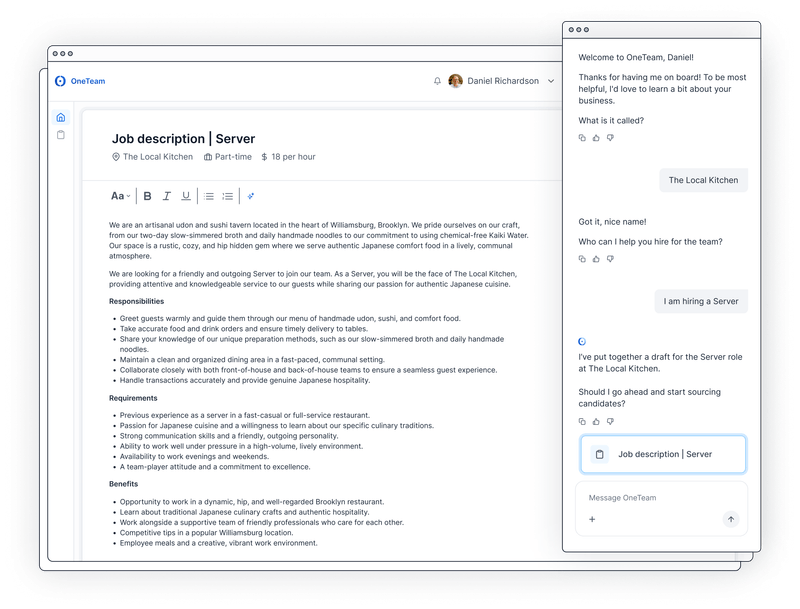
Operators comparing options before committing to one tool should review the available AI tools for generating job descriptions to find what fits their hiring volume and team size. Connecting that process to the right candidate sourcing software means qualified candidates are actually reaching the posting, not just whoever happens to search for it.
How the GM Role Fits Into Your Restaurant's Staffing Structure
Understanding how the GM connects to every other position in the building is what separates restaurants that run consistently from those that depend entirely on one person to hold everything together.
A GM who understands the full scope of positions in a restaurant staff makes better hiring decisions, sets clearer expectations by role, and builds a team that can absorb turnover without the entire operation feeling it. Restaurants that treat the GM as the only real leadership position tend to create exactly the kind of dependency that makes turnover at that level catastrophic.
For operators who are actively writing or updating job descriptions across multiple roles at the same time, reviewing job descriptions for restaurants to attract talent helps ensure that every posting, from runner to GM, meets the same standard of clarity and specificity. Inconsistent job descriptions across a team produce inconsistent hires, and that problem compounds quickly in a high-turnover environment.
Where OneTeam Fits Into GM-Level Hiring
Hiring a general manager is one of the highest-stakes decisions a restaurant owner makes. The process takes longer, the candidate pool is smaller, and the cost of a wrong hire is felt across every shift for months. Most operators do not have a structured hiring process at the GM level because they have never needed to build one. Knowing how to improve your restaurant hiring process before a GM vacancy opens is the difference between a deliberate hire and a desperate one.
OneTeam gives operators a clearer, more organized way to manage the hiring process regardless of the role. Instead of tracking candidates across text threads and email inboxes, managers get a single view of who is in the process, where they are, and what the next step is.
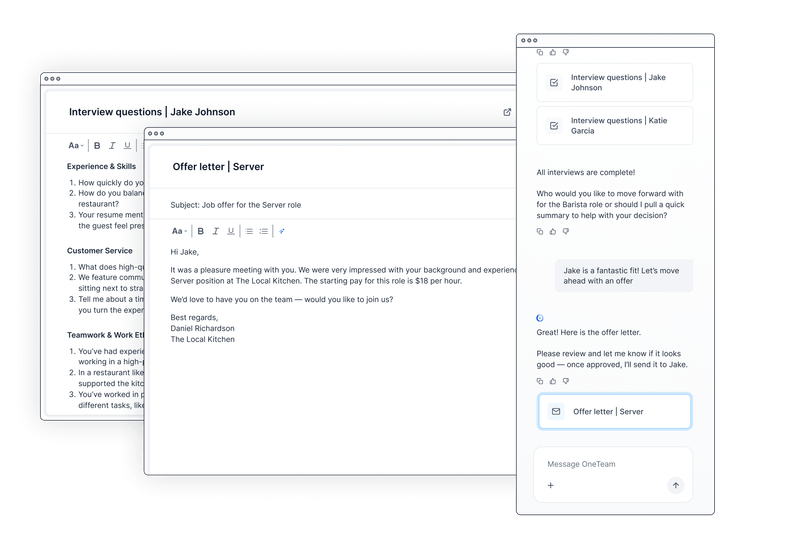
For restaurants hiring leadership roles and hourly staff at the same time, ai hiring software can help keep candidate screening, interview coordination, and hiring decisions connected in one process.
Operators who want to tighten the front end of the process can use automated candidate screening to filter applications before they ever reach the interview stage. For the posting itself, learning how to use an AI job description generator for faster hiring cuts the time spent writing and rewriting descriptions that still miss the mark. Both save time at the stage where most operators lose it.
FAQ


No setup fees.
No long-term commitment.
Create your account and start hiring.
