
Job Description for Restaurant Staff That Attracts Talent
TL;DR
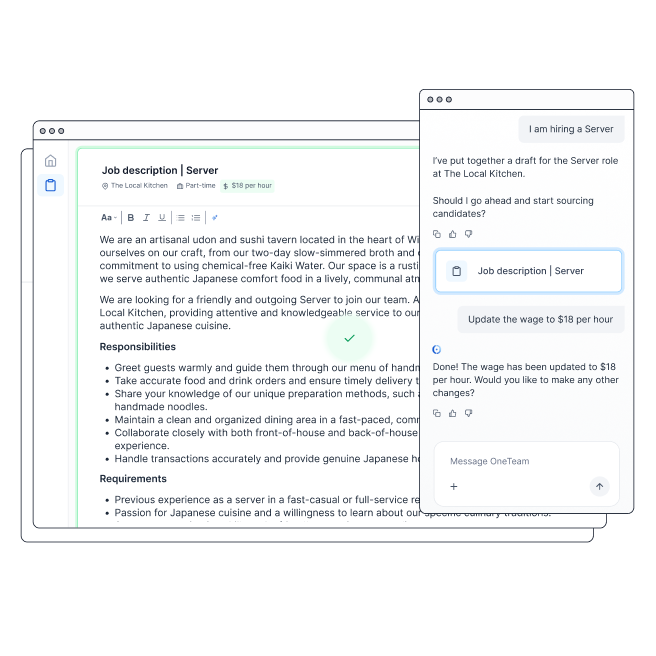
Restaurant turnover starts with a weak job post. A clear, specific description with a real pay range brings in better candidates and cuts your time spent re-hiring. Tools like OneTeam's job description generator help you post faster and respond before good applicants move on.

Lyuba



Restaurant hiring never really stops. Someone leaves mid-week, and suddenly a general manager is writing job posts, sorting applications, and still trying to run the floor. A job description generator can take one of those tasks off your plate quickly. But it only works when the description itself is clear and honest.
Most turnover problems in restaurant staff roles start with a weak job description. It pulls in the wrong candidates, wastes interview time, and puts you right back where you started. Fixing the post first is one of the most practical moves in restaurant management.
What to Include in a Restaurant Staff Job Description
Writing a job description does not have to take an hour. Here are the five basics every strong restaurant job post needs to cover.
Job title and summary
Use a title that matches the role. "Line Cook" and "Server" are clearer than "Kitchen Team Member" or "Hospitality Associate." A short two-sentence summary of the restaurant staff roles and what the position involves covers what candidates need to know.
Key responsibilities
Keep this list specific to the job. Responsibilities vary by position, so do not use the same list for every role. Common examples across kitchen staff and front of house roles include:
- Taking and processing orders accurately
- Supporting chefs, line cooks, and assistant managers during service
- Maintaining cleanliness standards throughout the shift
- Communicating clearly with the rest of the team
Skills and experience
List only what the role genuinely requires. For front-of-house positions, familiarity with a POS system (point-of-sale system) is a fair ask. Kitchen roles may require knowledge of health and safety regulations or experience managing inventory.
Salary and benefits
Give a real number or a range. Candidates move on quickly when pay is missing from a post. Mention shift meals, tips, or scheduling flexibility if those apply.
Work environment and culture
Be direct about what the job actually looks like day-to-day. A fine-dining establishment operates differently from a high-volume neighborhood spot. If you run one of the city's fine dining restaurants, make that clear in the post. Describe the dining room pace, the team size, and what a normal shift actually looks like.
Tips to Attract Better Candidates
A good job post does not just list tasks. These three tips will help your stand out to the candidates worth hiring.
Be clear and specific
Tell team members exactly what to expect before their first shift. If you need someone available every Friday night rush, put that in the post. Vague schedules and unclear roles are why experienced candidates move on to the next post. Responding to applicants promptly also signals that your restaurant is organized and worth joining.
For busy managers, ai hiring software can help keep candidate follow-up, screening, and interview coordination moving once the right applicants start coming in.
Highlight perks and growth
Not every perk is about pay. A strong dining experience, staff meals, and a clear path from line cook to sous chef can matter just as much as the hourly rate. Candidates want to see a path forward. That detail alone can bring in people who actually stay.
Use simple, engaging language
Write the post the same way you would explain the job to someone on the floor. Skip the formal tone and the long paragraphs. If it sounds like a corporate memo, the right candidates will not finish reading it.
Common Mistakes to Avoid
These three mistakes are more common than most managers realize, and each one quietly adds days to your hiring process.
Vague descriptions
Phrases like "must be a team player" attract people who misread the role. In restaurant management, that means someone shows up, realizes the job is not what they pictured, and leaves after one shift.
Unrealistic requirements
Stacking too many tasks into a single entry-level post makes the role seem overwhelming. Strong candidates talk themselves out of applying before they even finish reading it.
Missing salary info
Skipping the pay range means every applicant asks the same question. That is time away from the floor that could have been avoided.
Simple Job Description Template
Use this as a starting point. Copy it, fill in the brackets, and post it in under five minutes.
[Job Title] [Restaurant Name] | [Neighborhood, NYC]
About the role: We are looking for a [Job Title] to join our team at [Restaurant Name]. This is a [full-time/part-time] position on our [front of house/kitchen] staff.
Responsibilities include
- [Primary task, e.g., taking and processing orders]
- [Secondary task, e.g., maintaining cleanliness standards]
- [Additional task, e.g., supporting the team during rush hours]
What we are looking for
- [Required skill, e.g., POS system experience]
- [Required skill, e.g., knowledge of health and safety regulations]
- [Experience level, e.g., one or more years in a similar role]
Pay and schedule [Pay Range] per hour, plus [tips/benefits if applicable]. Shifts run [days and hours].
Our team [One sentence describing the dining room atmosphere, team size, or type of service.]
The Bottom Line
A clear job description does not just fill an open shift. It brings in people who show up, stay, and do the job well, so you are not starting over two weeks later. That is time back on the floor, where you need to be. Once the right candidates start coming in, the next problem most managers run into is responding before those applicants move on.
That is where OneTeam comes in. It is a hiring assistant built for restaurants. It screens applicants, schedules interviews, and keeps the process moving for you. See how OneTeam can help you hire faster and get back to the floor.
FAQ


No setup fees.
No long-term commitment.
Create your account and start hiring.
