
A Guide for Restaurant Hiring with AI in Recruitment
TL;DR
AI in recruitment helps restaurants hire faster, reduce staffing gaps, and spend less time on manual hiring tasks. By automating screening, scheduling, and candidate communication, restaurants can build more stable teams and keep managers focused on operations instead of constant hiring.

Helgi



Most restaurant managers are not bad at hiring. They are just doing it under the worst possible conditions. Someone quits mid-week, the schedule falls apart, and suddenly hiring is urgent while service still has to run.
There is no time to post thoughtfully, screen carefully, or schedule interviews without something else falling through the cracks. So the process gets compressed. Rushed. And the results usually show it.
That kind of reactive hiring is one of the most common pain points in the industry, and it is also one of the most fixable.
AI in recruitment gives restaurant managers a way to move faster without adding more complexity to an already full plate. It handles the repetitive parts of hiring, like sorting applications, flagging strong candidates, and scheduling interviews, so the process stays organized even when everything else is busy.
In this guide, we will look at how AI in recruitment works, where it helps most, and what it can do for restaurants that need to hire quickly and stay focused on operations.
What Is AI in Recruitment?
For most restaurant managers, AI in recruitment simply means using software to handle the repetitive parts of hiring. Instead of reviewing every resume manually, sending dozens of follow-up messages, or going back and forth to schedule interviews, the system helps organize and automate those steps.
This does not replace the manager or make hiring decisions automatically. Managers still decide who to interview and who to hire. The difference is that the software handles the time-consuming work in the background so managers can focus on choosing the right person for the team.
In restaurants, this usually shows up in a few practical ways:
- Sorting and organizing job applications
- Highlighting strong candidates quickly
- Automatically scheduling interviews
- Sending follow-up messages to applicants
- Keeping hiring organized across locations
Instead of juggling emails, texts, resumes, and spreadsheets, everything sits in one place. The goal is not to make hiring complicated. It is to make the process faster and easier so managers can fill roles without spending hours on administrative work.
The Real Cost of a Slow Hiring Process
An open shift does not just mean one less person on the floor. It sets off a chain reaction that affects every part of the operation.
The team that shows up has to cover the gap. Servers take on extra tables. Line cooks push through a rush that was built for one more set of hands. It gets done, but it costs something. When a team is consistently short-staffed, the ripple effects show up fast:
- Slower Service
- More mistakes
- Staff burnout
- Strong employees leave
What starts as one open shift quickly spreads across the restaurant. The longer the role stays open, the more pressure builds on the team, the service, and the guest experience. That is why how quickly a restaurant moves from job posting to hiring matters more than many operators realize.
How to Use AI in Your Hiring Process from Start to Finish
For many restaurant managers, the hiring process breaks down in a few familiar places. Job posts do not reach enough candidates. Applications pile up faster than anyone can review them. Interview scheduling turns into a long chain of texts and missed calls.
The best ai recruiting software helps organize the entire process from the moment a job opens to the moment interviews begin. With platforms like Oneteam, managers can keep everything in one place and move through hiring without the usual back and forth.
1. Attracting the Right People (Beyond a “Now Hiring” Sign)
Many restaurants still rely on a sign in the window or a single job post to attract applicants. While that can bring in candidates, it often limits how many people actually see the job opening. See some of our best hiring ideas for restaurants.
Hiring software can publish job descriptions across multiple job boards at the same time. Instead of posting the same role on several platforms manually, managers can create one job listing and distribute it to several hiring channels.
For example, a single job post can be shared across:
- Multiple job boards
- Career pages
- Mobile job platforms
- Restaurant hiring networks
Another advantage is the ability to build a talent pool. When candidates apply but are not hired immediately, their information stays in the system. The next time a position opens, managers already have a list of interested applicants to review instead of starting the search from scratch.
2. Finding the Best Candidates Without Reading 100 Resumes
One of the biggest challenges in restaurant hiring is the number of applications that arrive after a job post goes live. Managers often spend hours opening resumes, scanning for experience, and trying to figure out which candidates might actually be available for the role.
With AI in recruitment, the system reviews every application and highlights candidates who match the role’s basic requirements. This might include factors such as:
- Previous restaurant experience
- Availability for specific shifts
- Location or commute distance
- Relevant skills for the position
Instead of sorting through every resume individually, managers can focus on a shorter list of candidates who are more likely to be a good fit. This makes it easier to move quickly while still reviewing applicants carefully.
3. Scheduling Interviews Without the Back-and-Forth
Interview scheduling is one of the most frustrating parts of hiring. Managers text candidates to find a time. Candidates respond hours later. Schedules change, shifts get busy, and interviews get delayed or fall through.
Automated interview scheduling simplifies this step by allowing candidates to choose from available interview times. The process usually works like this:
- Managers set available interview slots
- Candidates choose a time that works for them
- The interview is automatically added to the calendar
- Both sides receive confirmation details
There are many benefits of automated interview scheduling tools, mainly removing the constant back-and-forth messages that slow the process down. With OneTeam, candidates can book interviews quickly, and managers can stay focused on preparing for the conversation instead of coordinating logistics.

The Real-World Benefits of Using AI for Restaurant Hiring
For many restaurants, hiring problems are not complicated. The real issue is time. Managers already juggle schedules, inventory, call-outs, and the dinner rush. When hiring becomes another long, manual process, it often gets pushed to the side until the situation becomes urgent.
Using AI in recruitment helps simplify those everyday hiring challenges. Instead of adding more work, it helps restaurants move faster, stay organized, and spend less time on repetitive tasks.
You Hire Faster
When a position opens, speed matters. Good candidates often apply to several restaurants at once, and the first place to respond usually gets their attention.
AI helps move the process forward by organizing applications and helping managers identify qualified candidates sooner. Instead of spending days reviewing resumes and coordinating interviews, managers can move strong applicants to the next step quickly.
For restaurants trying to cover shifts, that speed can make the difference between filling a role in a few days or leaving it open for weeks.
You Make Better Hires
Hiring quickly is important, but hiring the right person matters even more. High turnover often happens when managers have to rush decisions just to get someone on the schedule.
By helping organize applications and highlight candidates who meet the role’s requirements, AI in recruitment gives managers a clearer view of their options. Instead of scanning resumes quickly and hoping for the best, they can review a smaller group of candidates who are more likely to fit the job.
That extra clarity can help restaurants choose people who stay longer and work well with the team.
You Get Your Time Back
Many hiring tasks are repetitive. Posting jobs, responding to applicants, and coordinating interviews all take time away from running the restaurant.
The best ai hiring softwares can help handle much of that administrative work in the background. Applications stay organized, candidates receive updates automatically, and interview scheduling becomes simpler.
That means managers can spend less time managing hiring logistics and more time focusing on the restaurant and meeting promising candidates.

It’s Easier for Applicants
A slow or confusing hiring process can push candidates away. If applicants wait too long for a response or struggle to schedule an interview, they often move on to another opportunity.
A smoother process creates a better first impression. Candidates receive updates quickly, scheduling becomes easier, and the entire experience feels more professional.
For restaurants competing for staff, that positive experience can make a difference in attracting and keeping strong candidates.
Why Restaurants Using AI in Recruitment Are Pulling Ahead
The way candidates look for restaurant jobs has changed. Job seekers no longer apply to one place and wait. They send applications to several restaurants at once and take the first solid offer that comes through, which means the restaurants that respond quickly and run an organized process are the ones securing strong candidates while everyone else is still trying to schedule a first interview.
Using AI in recruitment helps restaurants move at that pace. Applications get reviewed sooner, candidates hear back faster, and interviews get scheduled without the usual delays. When the process runs smoothly, strong candidates stay engaged instead of accepting something else while they wait to hear from you.
There is also a longer-term benefit that goes beyond any single hire. When the recruitment process stays organized, managers are not starting from scratch every time someone leaves. They move through the same workflow, keep the talent pool active, and maintain a fully staffed team without the constant pressure of last-minute hiring.
For restaurants dealing with high turnover, that consistency is what finally breaks the reactive cycle for good.
Restaurant Hiring Shouldn’t Feel Like a Constant Emergency
The restaurants that remain fully staffed are not necessarily those with the largest budgets or the most applicants. They are the ones that stopped treating hiring as something to deal with when things fall apart and started treating it as part of how they run the operation.
That shift does not require overhauling everything at once. It starts with removing the parts of the process that eat up the most time: the resume sorting, the scheduling back-and-forth, and the follow-ups that never happen because the service got busy. For a closer look at how to use AI in restaurant hiring at each of these stages, OneTeam's guide breaks down the practical steps.
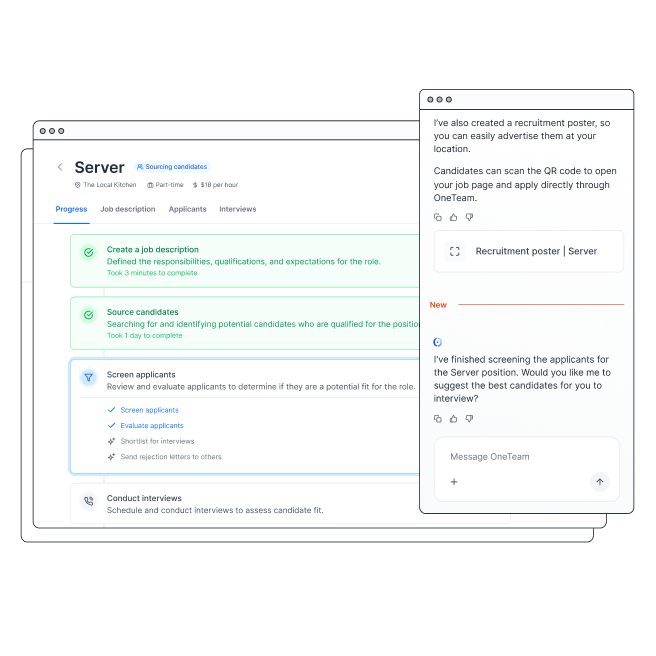
When those steps run in the background, managers can focus on what actually requires their judgment: choosing the right person for the team.
That is what AI in recruitment makes possible. Not a perfect hiring process, but a consistent one. And in an industry where turnover is constant and good candidates move fast, consistency is the advantage. Tools like OneTeam are built specifically for restaurant operators who need hiring to work without adding another thing to manage. If you are ready to stop scrambling every time a role opens, this is a good place to start.
FAQ


No setup fees.
No long-term commitment.
Create your account and start hiring.
