
An Expert Guide on AI in Recruitment
TL;DR
AI in recruitment helps hiring teams manage the growing complexity of modern hiring by automating repetitive administrative tasks like resume screening, interview scheduling, and candidate communication. Instead of replacing recruiters, AI tools organize candidate information, improve hiring speed, and make high-volume recruitment more efficient and consistent.

Helgi



Hiring has never been a small ask, but lately it has become unmanageable, and not because candidates are hard to find. In most industries, teams already have more applications than they can handle.
The real problem starts after applications come in. Managers spend hours reviewing resumes, sorting candidates, chasing follow-ups, and trying to lock in interviews, all while the rest of the operation keeps moving.
AI in recruitment is built to handle that pressure. It does not replace hiring decisions. It takes the administrative work off managers so they can move faster and stay focused on choosing the right people.
Teams using AI-assisted hiring are seeing faster time-to-hire, more consistent screening, and far less time spent coordinating. This guide breaks down how AI in recruitment works, where it fits into the hiring process, and what restaurants and other high-turnover teams are learning from using it day to day.
The Real Hiring Problems AI Is Designed to Solve
The conversation around AI in recruitment tends to start with the technology, but the more useful place to start is with the problem it was built to solve. Recruiting has always required coordination, but the scale and pace of modern hiring have stretched manual processes well past their limits.
A decade ago, a recruiter could review applications at a reasonable pace, schedule interviews one at a time, and make hiring decisions without being buried in administrative work. That is no longer the case.
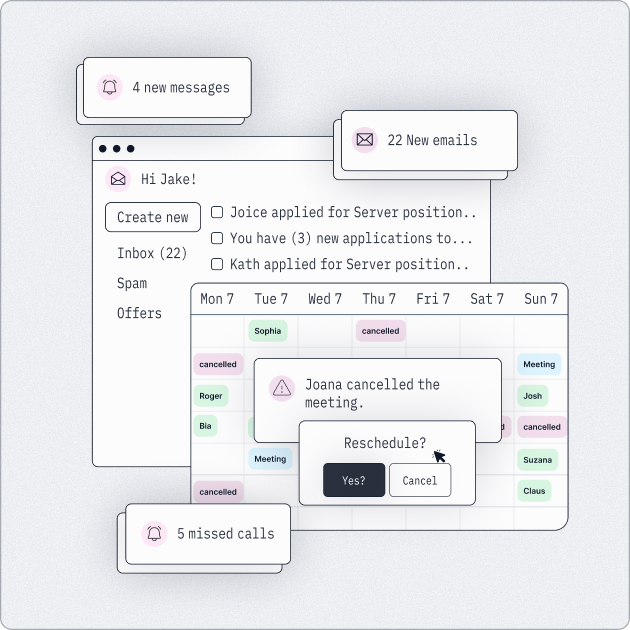
Job postings now generate application volumes that make manual screening slow and inconsistent, candidates expect faster responses than most teams can deliver, and recruiters are expected to manage multiple roles and multiple stages of evaluation at the same time, often across disconnected tools that were never designed to work together.
Some of the most common challenges include:
- Application overload: A single role can generate dozens or even hundreds of resumes, making manual screening slow and inconsistent.
- Fragmented hiring workflows: Recruiters often juggle job boards, spreadsheets, messaging apps, and calendar scheduling tools just to move candidates through the interview process.
- Interview coordination bottlenecks: Coordinating availability between recruiters, hiring managers, and candidates frequently delays hiring decisions.
- Inconsistent candidate evaluation: Without structured systems, different candidates may be assessed using different criteria.
- Administrative workload that crowds out real recruiting: Much of a recruiter’s time is spent organizing applications, scheduling interviews, and sending updates rather than evaluating candidates.
These are the problems AI in recruitment is designed to address, not by taking over the process, but by removing the administrative friction that makes the process so difficult to run well.
The New Infrastructure Behind Modern Recruiting
Recruitment has quietly become one of the more complex operational systems a business has to manage. Gone are the days when a job board post and a spreadsheet were enough to keep up.
That shift gave rise to dedicated recruitment platforms, most notably applicant tracking systems, which centralize candidate data, job postings, and hiring workflows into a single place.
Within a modern recruitment system, different technologies typically support different functions:
- Applicant tracking systems (ATS) organize applications, job postings, and candidate records in a central platform.
- Hiring software helps recruiters manage interview pipelines, hiring stages, and collaboration with hiring managers.
- AI hiring assistants support operational tasks such as resume screening, candidate messaging, and interview scheduling.
Teams that hire frequently often use tools like OneTeam to manage these steps in one place instead of jumping between multiple systems.
This infrastructure is particularly valuable for organizations that hire frequently. When recruiting becomes a continuous process rather than an occasional activity, centralized systems allow hiring teams to move candidates through the process more efficiently while maintaining visibility across multiple roles and applicants.
Why AI in Recruitment Is Solving a Data Management Problem
Recruiting decisions rarely fail because recruiters lack information about candidates. More often, the difficulty lies in organizing that information in a way that makes comparisons clear.
Each candidate introduces multiple data points into the hiring process. Resumes outline work history and skills. Interview stages generate feedback from different evaluators. Scheduling tools track availability and interview outcomes. Communication with candidates adds another layer of updates and context.
As interview volume increases, even scheduling can become part of the administrative overload. Coordinating calendars, rescheduling interviews, and managing candidate availability across multiple stakeholders often creates additional complexity for hiring teams. Many companies now use tools like automated interview scheduling software to reduce manual coordination and keep hiring workflows moving more efficiently.
On their own, these inputs are manageable. Together, they create a growing set of information that recruiters must organize before they can evaluate candidates clearly.
How AI Structures Candidate Information for Recruiters
Most candidate information enters the recruitment process in an unstructured form. Resumes vary in format, job titles are inconsistent across companies, and candidates describe their experience in different ways. Before recruiters can evaluate applicants effectively, this information must be interpreted and organized.
Artificial intelligence helps address this challenge by converting unstructured candidate information into structured data that can be analyzed and compared more easily.
AI recruitment tools typically perform several types of analysis when processing candidate information:
- Skill extraction. AI systems can identify relevant skills, certifications, and work experience from resumes and candidate profiles.
- Experience categorization. Job titles and responsibilities can be grouped into broader categories, allowing recruiters to compare candidates with similar backgrounds.
- Candidate summarization. Instead of reviewing raw resumes, recruiters can see condensed candidate profiles that highlight the most relevant information for the role.
- Qualification matching. AI systems can compare candidate information against job requirements and highlight applicants whose experience aligns with the position.
These capabilities allow recruiters to review applicants more efficiently while maintaining visibility into the details that matter for hiring decisions.
Rather than replacing resume evaluation, AI tools help organize candidate information in ways that make comparisons easier and more consistent.
How AI Helps with High-Volume Hiring
The benefits of AI in recruitment become most visible in environments where hiring occurs frequently.
Industries such as hospitality, retail, customer service, and logistics often experience ongoing hiring needs. Roles open regularly as businesses expand, employees change jobs, or seasonal demand increases. As a result, managers and recruiters may review hundreds of applications over the course of a year.
In these environments, manual hiring processes quickly become difficult to sustain. Reading every resume, coordinating interview availability, and communicating with candidates requires significant time and coordination.
AI tools are increasingly used to support these high-volume hiring environments by helping teams manage large applicant pools more efficiently.
For example, AI systems can:
- Organize applicants into structured candidate pipelines
- Highlight candidates whose experience aligns with the job description
- Summarize applicant profiles for faster review
- Automate parts of interview coordination and candidate communication
For restaurants and hospitality businesses, these capabilities can be especially valuable. Managers are often responsible for hiring while also running daily operations, which leaves limited time for reviewing resumes or coordinating interviews.

The Limits of AI in Recruitment
Despite its growing role in hiring operations, artificial intelligence does not replace the need for human judgment in recruitment.
Hiring decisions involve evaluating qualities that are difficult to capture through data alone. Motivation, communication style, teamwork, and long-term potential often emerge during interviews and conversations rather than through resumes or application forms.
AI systems can assist with organizing information and highlighting relevant candidates, but they cannot fully evaluate these human factors.
There are also broader considerations that organizations must keep in mind when implementing AI tools in recruitment. Some of the most common concerns include:
- Bias in training data
- Over-automation
- Transparency
For these reasons, most organizations treat AI as a decision-support tool rather than a decision-maker. Recruiters remain responsible for evaluating candidates, conducting interviews, and making final hiring decisions.
What Organizations Should Consider Before Adopting AI Hiring Tools
For organizations considering AI in recruitment, the most effective approach is often to start with the parts of the hiring process that involve repetitive administrative work.
Tasks like resume screening, interview coordination, and candidate communication take up hours but do not require the same level of judgment as evaluating candidates. These are the areas where AI tools can provide the most immediate value.
When implementing AI hiring tools, organizations should focus on a few practical considerations:
- Integration with existing systems: AI tools should work with your existing applicant tracking system software, so candidate information stays in one place instead of being scattered across multiple tools.
- Clear human oversight: AI can organize and surface candidate information, but hiring decisions should remain with recruiters and managers. Oversight keeps the process consistent and fair.
- Simplicity of workflows: Choose tools that make hiring easier, not more complicated. Many managers are still skeptical of hiring software because older systems required too much setup and manual work.
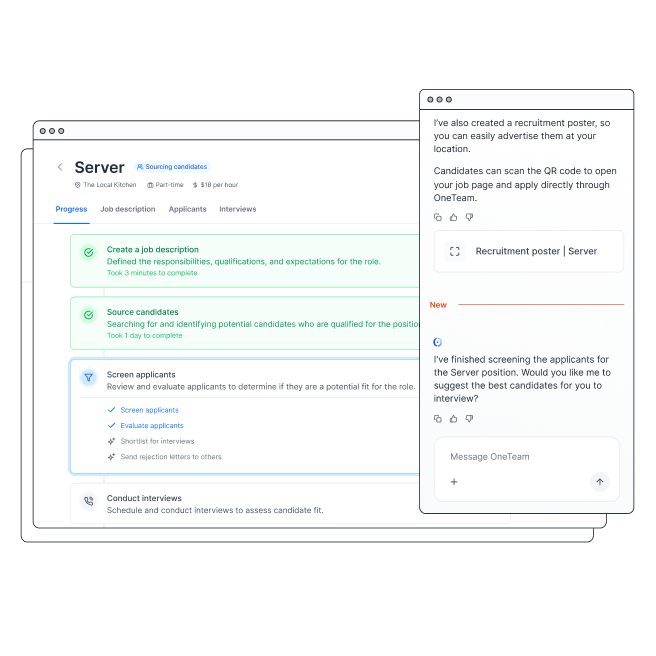
Tools like OneTeam illustrate how AI can support hiring without complicating the process. Instead of managing resumes, interview scheduling, and candidate communication across multiple platforms, hiring teams can review structured candidate summaries and move applicants through the hiring pipeline in one place.
FAQ


No setup fees.
No long-term commitment.
Create your account and start hiring.
