
Restaurant Staffing Agency NYC Hiring Guide
TL;DR
A NYC restaurant staffing agency can be a strong short-term fix for turnover, seasonal rushes, and emergency staffing gaps. NYC’s labor costs, frequent no-shows, and constant competition make agencies useful for temp, event, or urgent coverage, but pricing can quickly cut into margins. The smartest operators use agencies strategically while building stronger in-house hiring systems for long-term staffing control.

Helgi



Restaurant staffing shortages in New York City create operational pressure that impacts service quality, labor costs, employee burnout, and profitability. Every open role forces restaurants to compensate somewhere else through overtime, stretched management teams, slower service, or added pressure on existing staff.
For many operators, using a restaurant staffing agency in NYC is less about convenience and more about maintaining operational stability when internal hiring cannot keep pace.
Staffing agencies can help restaurants fill urgent labor gaps faster, especially during periods of high turnover or seasonal demand. However, agencies are not always the best long-term solution. Higher agency markups can increase labor costs without solving the underlying hiring and retention problems causing constant staffing shortages.
Understanding when staffing agencies create real value, and when stronger in-house hiring systems are the better investment, is key to building a more sustainable restaurant workforce.
Why NYC Restaurants Face a Different Staffing Economy
Restaurant hiring in New York City operates under a different level of pressure than most markets. Wage competition is aggressive. Candidate churn is constant. Seasonal swings can sharply increase labor demand, while commuting complexity and borough-specific labor pools make recruiting less predictable.
For operators managing multiple locations or teams of 15 to 50 employees, staffing volatility becomes an ongoing business risk.
NYC-specific staffing pressures include:
- High employee turnover
- Rising hourly labor costs
- Seasonal surges tied to tourism and holidays
- Frequent no-shows
- Competition from hospitality groups and gig work
- Limited manager time for manual hiring
This is why many restaurants eventually look beyond basic hiring and start evaluating broader Restaurant Staffing strategies instead of treating every vacancy like a one-off emergency.
When a Restaurant Staffing Agency Makes Strategic Sense
Staffing agencies are often most effective when speed directly protects operations. In high-pressure situations, immediate staffing support can prevent lost revenue, preserve service standards, and reduce burnout on existing teams.
Best use cases for staffing agencies:
- Emergency BOH or FOH shortages
- Holiday or seasonal volume spikes
- Catering and event staffing
- Temporary expansion periods
- Specialized or hard-to-fill hospitality roles
Key strategic advantage:
Agencies reduce sourcing time by giving operators faster access to pre-screened workers.
Core tradeoff:
That speed usually comes at a premium. For restaurants operating on thin margins, agencies should often function as tactical support, not a permanent replacement for structured hiring.
Agency vs In-House Hiring
The wrong comparison is hourly wage versus hourly wage. The right comparison is operational cost versus operational outcome.
Agency Hiring
Benefits:
- Faster staffing
- Reduced sourcing burden
- Temp flexibility
- Immediate labor access
Costs:
- Markup fees
- Temp premiums
- Lower culture fit
- Potential retention issues
In-House Hiring
Benefits:
- Lower long-term labor cost
- Better retention potential
- Greater quality control
- Stronger team consistency
Costs:
- Resume screening burden
- Scheduling demands
- Slower hiring cycles
- Manager bandwidth strain
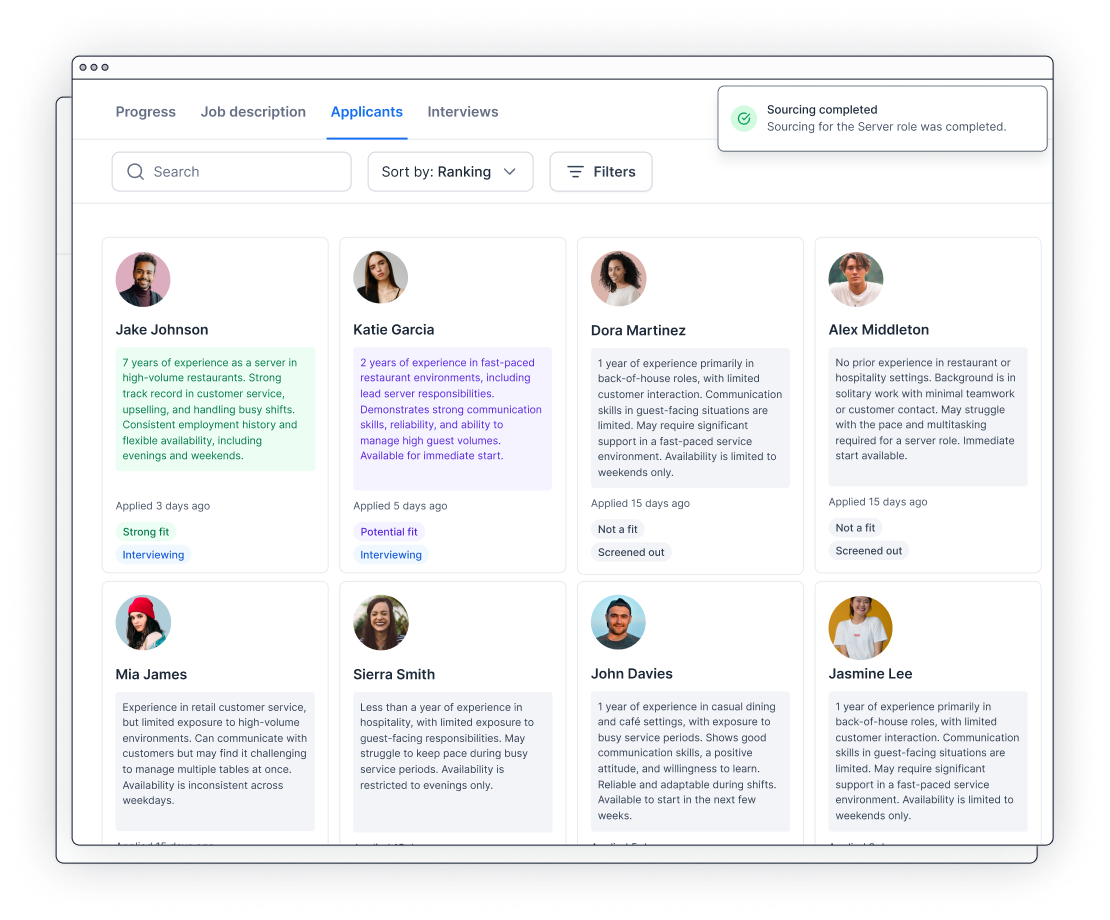
This is where systems like an Applicant tracking system can become more financially valuable than repeated agency dependence. Instead of paying premium markups repeatedly, restaurants can reduce internal bottlenecks and improve direct hiring speed. AI hiring assistant's like OneTeam can help operators spend less time sorting applications and coordinating interviews while keeping hiring moving.

Understanding NYC Staffing Agency Pricing Models
Most restaurant staffing agencies in New York City use a few standard pricing models, but the real cost often depends on more than the hourly rate.
Common NYC staffing agency pricing models:
- Temporary staffing markup: The most common pricing model. Restaurants pay the worker’s hourly wage plus an agency premium, often ranging from 25% to 75% depending on role, urgency, and scheduling demand.
- Temp-to-hire: Typically involves a higher temporary rate upfront, followed by a conversion fee if the restaurant decides to hire that employee permanently.
- Direct permanent placement: Agencies often charge 15% to 30% of annual salary, which can make management or specialized kitchen hires significantly more expensive.
- Managed staffing contracts: More common for larger operators, this model provides broader outsourced staffing support across multiple roles, departments, or locations.
The bigger issue is that pricing is not always as straightforward as it first appears. Markup may change based on shift timing, overtime can carry inflated rates, and conversion fees or booking minimums may create added costs that are easy to overlook during urgent hiring situations.
Critical pricing questions to ask:
- Is markup flat or variable?
- Are there no-show replacement guarantees?
- Are overtime rates inflated?
- Is there a permanent hire conversion fee?
- Are there minimum booking thresholds?
Without clear pricing transparency, staffing agencies can help solve immediate labor shortages while quietly increasing long-term labor spend.
Red Flags When Choosing a Restaurant Staffing Agency NYC Operators Can Trust
Not all staffing agencies understand hospitality pressure. Many broad staffing providers focus on filling vacancies, not protecting restaurant performance.
Major warning signs:
- Weak FOH or BOH specialization
- Limited hospitality recruiting depth
- Poor communication speed
- No replacement guarantee
- Vague pricing
- Excessive temp conversion penalties
Better indicators:
- NYC restaurant-specific expertise
- Multi-location support
- Seasonal staffing capability
- Strong screening standards
- Transparent markup models
Choosing an agency should feel like adding operational support, not adding another layer of uncertainty.

The Bigger Problem: Agencies Do Not Solve Reactive Hiring
This is where many operators hit the same wall. Agencies can fill shifts. They do not fix chaotic hiring systems. If managers are still manually writing job posts, reviewing every resume individually, and texting candidates between service periods, turnover will continue creating expensive emergencies.
That is why many restaurants eventually shift toward tools like an AI Job Description Generator to speed up role creation, automated Interview Scheduling to reduce coordination drag, and platforms like OneTeam’s AI Hiring Assistant to simplify repeat hiring without adding complexity. This shift is not about replacing staffing agencies entirely. It is about reducing how often agencies become necessary.
The Best Long-Term Model for NYC Restaurants
For most operators, the strongest hiring strategy is hybrid. AI hiring software can help restaurants build the internal side of that strategy by reducing manual screening, speeding up interview coordination, and keeping repeat hiring more organized.
Use staffing agencies for:
- Immediate labor shortages
- Seasonal surges
- Temporary flexibility
Use internal systems for:
- Core team growth
- Repeat hiring efficiency
- Turnover reduction
- Better hiring success
This approach protects short-term service while improving long-term labor economics.
Staffing Stability Protects NYC Restaurant Margins
In New York City, staffing decisions shape far more than hiring timelines. They affect labor costs, guest experience, manager burnout, and whether a restaurant stays operationally steady when turnover hits.
A restaurant staffing agency can be a valuable tool when speed matters most, especially during seasonal spikes, sudden shortages, or urgent front-of-house and back-of-house gaps. But speed alone does not build stability. When restaurants rely only on outside staffing to solve recurring labor problems, agency fees can pile up while deeper hiring inefficiencies remain untouched.
The operators who create stronger margins long-term usually take a broader view. They use staffing agencies when immediate coverage protects service, but they also strengthen internal systems to reduce reactive hiring, improve retention, and make future hiring less disruptive.
In a market as competitive and costly as NYC, the real advantage is not just filling shifts faster. It is building a hiring strategy that protects service today while creating a more resilient workforce tomorrow.
FAQ


No setup fees.
No long-term commitment.
Create your account and start hiring.
