
Hiring Staff for Restaurant Without Manager Burnout
TL;DR
Restaurant managers are expected to hire staff while simultaneously running service, managing schedules, and keeping teams on track. The hiring process gets pushed aside not because managers do not care, but because the demands of daily operations always feel more urgent. Restaurants that reduce the administrative side of hiring, through better tools and repeatable systems, are the ones that stop reacting to vacancies and start staying ahead of them.

Helgi



The role of a restaurant manager has expanded well beyond running service. Today, managers are expected to recruit new employees, review applications, schedule interviews, hire staff, and onboard new hires while keeping the floor staffed, guests happy, and service moving. For many restaurants, the hiring challenge is no longer finding time to interview candidates. It is finding time to manage the entire hiring process without compromising daily operations.
The restaurants that consistently succeed at hiring staff for restaurant operations are not asking managers to work longer hours. They are building hiring systems that reduce administrative work, improve consistency, and keep recruitment moving even during the busiest weeks. This article explores why restaurant hiring has become one of the biggest operational challenges managers face and what restaurants can do to make it more manageable.
Why Are Restaurant Managers Carrying More Than Ever?
Restaurant managers have always worn multiple hats. They oversee scheduling, manage labor costs, resolve guest issues, coach front-of-house and back-of-house teams, monitor inventory, and keep service running from open to close. Hiring has simply become another responsibility added to an already full workload.
Unlike many industries, restaurant hiring rarely happens in predictable cycles. Managers often recruit while covering shifts, preparing for weekend service, or responding to last-minute call-outs. That leaves little uninterrupted time to write a job description, review resumes, or identify candidates worth hiring before another restaurant extends an offer. An AI job description generator removes one of those steps entirely by building a role-specific posting in minutes instead of starting from a blank page every time.

The result is a hiring process that becomes reactive by necessity rather than by choice. Managers are not avoiding recruitment because they underestimate its importance. They are balancing it against every other operational priority competing for their attention, which is exactly the gap AI hiring software is meant to close.
Restaurant Hiring Never Happens at a Convenient Time
Restaurant vacancies rarely appear when business is quiet. Employees resign before busy weekends, seasonal demand creates sudden staffing gaps, and unexpected turnover places immediate pressure on the rest of the team. Every open position increases the workload for the employees who remain.
Under those conditions, speed often becomes the priority. Managers need someone on the schedule as quickly as possible, which leaves less time to evaluate applicants carefully or improve the hiring process itself. Automated interview scheduling is usually the fastest way to claw back some of that lost time, since coordination is one of the most repetitive parts of the process. The pressure to hire staff fast is understandable, but knowing where to hire restaurant staff before the vacancy opens often matters more than how fast a manager moves after, since rushed decisions tend to contribute to future restaurant staff turnover.
When Recruiting Gets Squeezed Between Shifts
When a manager is short-staffed and also trying to hire, the two responsibilities start working against each other. Time spent reviewing resumes is time not spent coaching the floor staff who are covering an extra section. Time spent coordinating an interview is time not spent checking in with the kitchen during a rush.
Most managers do not consciously choose one over the other. Service wins by default because it cannot pause, and hiring can. That default has a cost. Positions stay open longer than they need to, not because managers are not trying, but because the moment-to-moment demands of running a shift will always take priority over a task that can technically be pushed to tomorrow.

The managers who break this pattern are not working more hours. They are removing themselves from the parts of hiring that do not require their judgment, like posting job listings or chasing candidates for a response, so that the time they do spend on hiring goes toward decisions only they can make: who to interview, who fits the team, and who to hire.
Where Do Restaurant Managers Lose the Most Time During Hiring?
Hiring is made up of dozens of small tasks, and each one competes with the responsibilities of running the restaurant. On their own, none of these tasks seems particularly time-consuming. Together, they create hours of administrative work every week.
Managers typically spend the most time:
- Writing or updating job descriptions every time a position opens
- Reviewing large numbers of applications to identify qualified candidates
- Following up with applicants and answering hiring questions
- Coordinating interview times through calls, texts, and emails
- Rescheduling interviews after candidate no-shows
- Tracking applicants across spreadsheets, inboxes, and notes
- Preparing paperwork and helping onboard new hires
Most of this work does not directly improve hiring quality. It simply keeps the hiring process moving. As vacancies increase, administrative work grows with them, leaving managers with even less time to focus on coaching employees, supporting service, or leading their teams. A restaurant applicant tracking system is often the first thing that changes once managers stop tracking candidates across spreadsheets, inboxes, and notes, and pairing it with AI candidate sourcing closes the gap on the other end, before the resumes even arrive.
The Real Reason Hiring Always Gets Pushed to Tomorrow
Hiring is rarely a manager's only job, and it is rarely the one with a deadline that feels most urgent at the moment. On any given shift, a manager is pulled in multiple directions at once:
- A walk-in needs a table
- A supplier's delivery needs to be checked in
- A server needs help with a difficult table
Next to those, a stack of unread applications can wait, except it never actually does, because the longer it waits, the more pressure builds on the rest of the team.

This is the core tension in restaurant hiring. It is not that managers do not understand how to hire well. It is that hiring requires sustained, uninterrupted attention, and a restaurant shift rarely offers that. A manager might start reviewing applications between the lunch and dinner rush, only to get pulled away for a guest issue or a scheduling conflict before finishing. This is exactly where understanding how to source candidates earns its place, since it keeps qualified applicants moving through the process even when no one has five free minutes to push it forward manually.
The result is a hiring process that happens in fragments. Five minutes here, ten minutes there, spread across a week instead of concentrated into a single sitting. That fragmentation is what makes hiring feel disproportionately exhausting compared to the actual hours it takes. It is not the task itself that wears managers down. It is doing the task while also running everything else.
The Best Restaurant Managers Stop Starting From Zero
One of the biggest differences between reactive and effective hiring is not speed. It is preparation. Managers who consistently build strong teams rarely begin the hiring process after someone resigns. They have already created systems that make the next hire easier than the last, which usually comes down to three habits:
- Keeping past applicants organized
- Maintaining job descriptions that are ready to use
- Building relationships with promising candidates before an urgent vacancy appears
This approach improves hiring quality. When managers have access to a pool of candidates worth hiring, they can compare applicants based on experience, availability, and fit rather than making decisions under the pressure of an empty schedule. Candidate sourcing software makes that comparison faster by surfacing the strongest applicants first instead of leaving managers to sort through every resume manually.
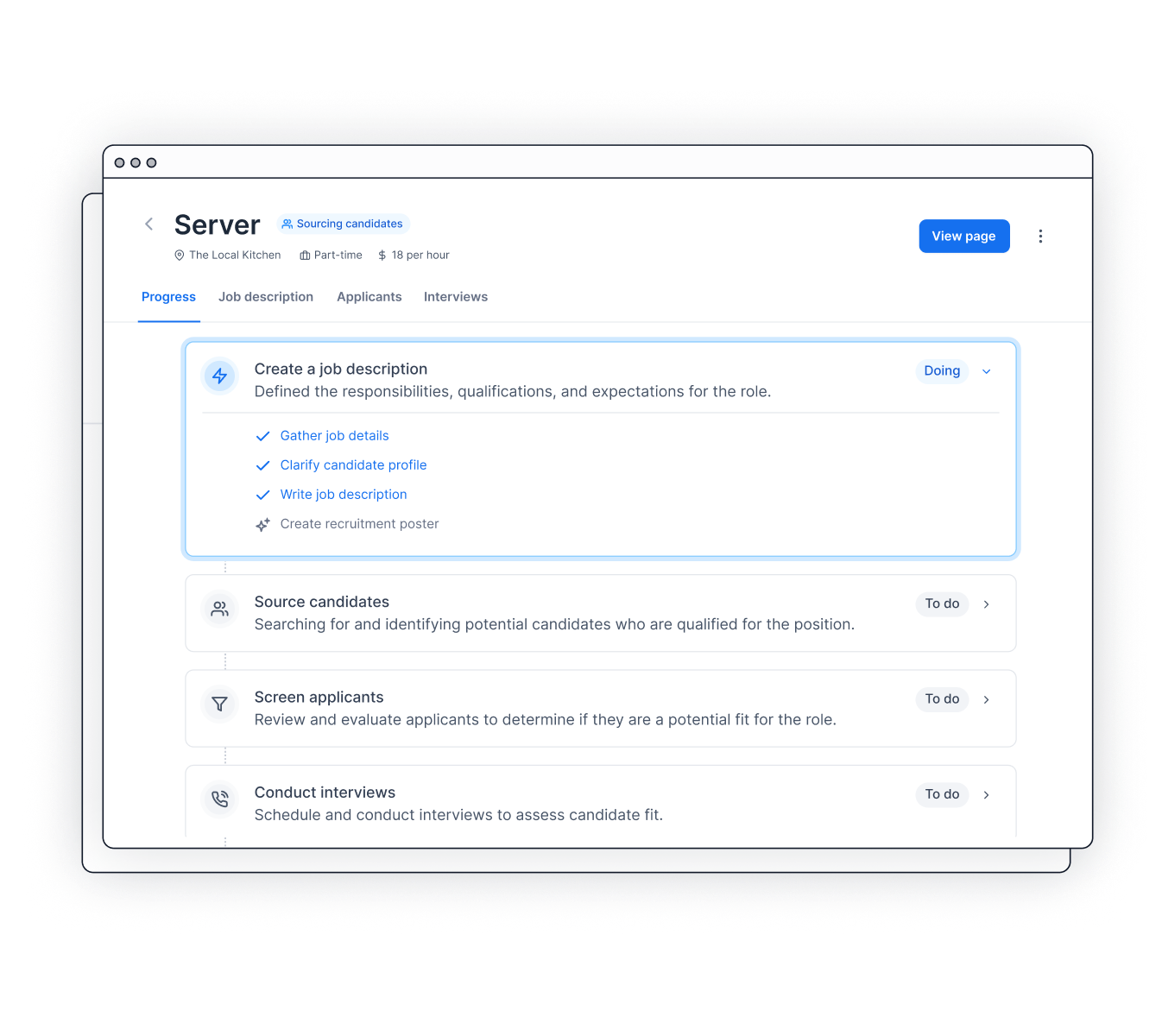
Building that kind of consistency does not require a dedicated HR team. It requires a hiring process that continues working alongside daily operations, allowing managers to stay ahead of staffing needs instead of constantly reacting to them. AI hiring assistant for restaurants are built to make that kind of consistency the default rather than something managers have to engineer on their own.
FAQ


No setup fees.
No long-term commitment.
Create your account and start hiring.
