
The Perfect Food Server Job Description
TL;DR
The server role is the most guest-facing and revenue-driving position on the floor, and one of the most frequently replaced. A clear food server job description sets expectations from day one, filters out the wrong candidates before the interview, and reduces the turnover that comes from hiring without a clear standard. Restaurants that define this role properly before posting tend to fill it faster and keep it filled longer.

Lyuba



Servers do not just deliver food. They drive revenue, manage the guest relationship from the first order to the final check, and keep the floor moving during the busiest hours of the night. When that role is filled with the wrong person, it shows up immediately in ticket times, in table turns, in complaints, and in check averages that never hit where they should.
A strong food server job description is not about listing tasks. It is about attracting candidates who can handle a high-volume floor, work accurately under pressure, and represent the restaurant professionally when things go wrong.
What Makes the Server Role Different From Every Other Position
Every front-of-house role matters, but the server role is the only one directly tied to revenue on every single shift. A hostess manages flow. A busser supports the floor. A server owns the transaction. They take the order, upsell the menu, manage the pace of the meal, handle complaints, and close the check. All of those roles report to the food and beverage manager, who defines what good service looks like across the entire floor. In a high-volume restaurant, the difference between a strong server and a weak one shows up in dollars at the end of every night.
That is why the food server job description matters more than most operators give it credit for. A vague posting attracts candidates who can carry plates. A specific one attracts candidates who can run a section, manage multiple tables simultaneously, and keep their composure when the floor is slammed and the kitchen is backed up.
Core Food Server Responsibilities
What a server actually does during a shift goes well beyond taking orders and delivering food. In a fast-paced restaurant environment, the role requires constant communication, accurate execution, and the ability to manage competing priorities without losing the guest experience at any table.
Day-to-day responsibilities typically include:
- Guest service and menu guidance
- Order taking and POS operation
- Upselling and revenue generation
- Food and beverage delivery
- Dietary and special request coordination
- Complaint resolution
- Kitchen and service coordination
- Payment processing
- Team support
- Issue escalation and communication
The Revenue Side of the Server Role
Most food server job descriptions focus entirely on duties and miss the most important part of the role entirely. Servers are the primary revenue drivers on the floor. Their ability to upsell a bottle of wine, suggest a dessert, or move a table efficiently directly affects the restaurant's nightly revenue and table turn rate.
Operators who hire for personality and availability alone often end up with servers who are pleasant but passive. The floor needs servers who understand that their job is not just to take orders. It is to guide the guest through a meal in a way that serves both the guest experience and the business.
Building that expectation into the job description from the start attracts candidates who understand the commercial side of the role, not just the service side.

Food Server Job Description Template
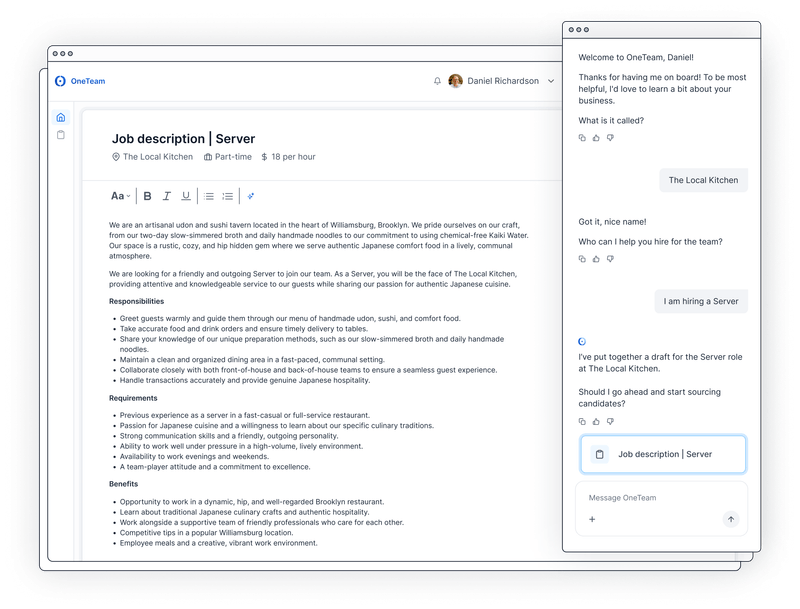
Every time a server leaves, and a manager rewrites this posting from scratch, that is time pulled directly off the floor. In restaurants running high-volume service across multiple locations, the same position opens repeatedly, and the posting should never have to be rebuilt from zero. An AI job description generator keeps a consistent, accurate posting ready to go the moment a role opens up.
Job Summary
The food server is responsible for delivering an excellent dining experience by taking orders accurately, serving food and beverages efficiently, upselling menu items naturally, and maintaining professional communication with guests and team members throughout service.
Responsibilities
- Take and enter food and beverage orders accurately using the POS system
- Deliver food and drinks in the correct sequence and at the right temperature
- Upsell menu specials, beverages, and add-ons during service
- Handle special requests and communicate dietary needs to kitchen staff
- Address customer complaints quickly and professionally
- Maintain table cleanliness and section organization throughout the shift
- Process payments and close checks accurately
- Support other team members during high-volume service periods
- Communicate delays, shortages, or issues to the floor manager
Requirements
- Prior experience as a restaurant server preferred
- Comfortable working weekends and holidays
- Ability to manage multiple tables simultaneously in a fast-paced environment
- Strong communication skills and attention to detail
- Familiarity with POS systems
- Composure under pressure during rush periods

Skills That Separate Strong Servers From Average Ones
Technical skills for this role can be taught. Menu knowledge, POS systems, and table sequencing are all trainable. What cannot be trained as easily is the ability to stay composed when three tables need attention at the same time, communicate a kitchen delay to a frustrated guest without losing the table, and upsell naturally without making the guest feel pressured.
The strongest server hires bring these qualities before they walk through the door:
- Ability to manage multiple tables accurately during high-volume service
- Clear and professional communication with guests and kitchen staff
- Natural upselling ability without being pushy
- Composure during rush periods and unexpected service disruptions
- Attention to detail on orders, modifications, and special requests
- Professional handling of customer complaints before they escalate
- Consistency on weekends and holidays when the floor is at its busiest
Why Server Turnover Is an Operational Problem, Not Just an HR One
Server turnover does not just cost time. It costs table turns, check averages, and guest experience every shift the floor runs short. When a server leaves mid-season, the remaining team absorbs the gap immediately. Sections get doubled up, ticket times slow down, and the servers still on the floor start burning out faster.
Most of that turnover is preventable. It starts with unclear expectations in the job description, a poor fit in the hiring process, and candidates who did not fully understand the demands of the role before their first shift. A specific food server job description that outlines the pace, the upselling expectations, the communication requirements, and the weekend and holiday availability needed reduces misalignment before anyone is hired.
For restaurants dealing with ongoing server turnover, restaurant ai hiring software reduces the manual work of reposting, screening, and scheduling interviews every time the position opens. OneTeam handles that process so managers spend less time on hiring admin and more time managing the floor where the team actually needs them.
How Restaurant Staffing Gaps Hit the Server Role Hardest
The server position is one of the first roles to feel the pressure when staffing runs thin. Operators looking for restaurant staffing shortage solutions often find the server section is where gaps show up first and hurt the most. Running one server short on a busy Friday night slows every table in the affected section, increases the chance of errors, and puts pressure on servers who are already at capacity.
Restaurants managing urgent gaps in their server teams sometimes use last-minute restaurant staffing options to cover shifts while longer-term hiring catches up. Having a clear and specific job description ready means those placements happen faster because the role requirements are already defined and do not need to be explained from scratch every time.

How to Interview a Food Server
The interview for a server role should be built around real situations, not hypothetical ones. Most candidates can recite the right answer when asked what they would do. What reveals whether someone can actually handle a high-volume floor is how they describe what they have already done, how they managed a section when they were short-staffed, how they handled a guest complaint that escalated, and how they stayed accurate when three tables needed attention at the same time.
Interview Questions That Reveal Real Ability
- Tell me about a shift where everything went wrong at once. How did you handle it?
- How do you approach upselling without making guests feel pressured?
- Describe a time you had to communicate a kitchen delay to a frustrated guest. What did you say?
- How do you stay organized when you are managing multiple tables during a rush?
- What does a strong section look like to you at the end of a busy Saturday night?
How a Specific Job Description Reduces Bad Server Hires
Bad server hires follow a predictable pattern. A vague posting goes up, a candidate who looks fine on paper comes in, gets through training, and leaves within six weeks because the role was not what they expected. The manager starts the process over while the floor runs short.
A food server job description that clearly outlines the pace, the upselling expectations, the POS requirements, and the weekend availability needed filters the wrong candidates out before the interview happens. Candidate screening software reduces the time spent manually reviewing applications and surfaces candidates who match the role before a single interview is scheduled.
Stop Filling the Same Role Twice
Server turnover is expensive, disruptive, and largely preventable. The restaurants that keep this position filled longer are the ones that define the role clearly before they post, hire for the right qualities before they train, and move fast when a vacancy opens.
Attract talent with a job description generator and spend less time rebuilding the same posting every time a server walks out. Every day that role sits open is another day the rest of the team picks up the slack. OneTeam helps operators move faster on every open role, so the floor stays covered and managers stay where they are actually needed.
FAQ


No setup fees.
No long-term commitment.
Create your account and start hiring.
