
Restaurant General Manager Job Description Guide
TL;DR
A strong restaurant general manager job description does more than list responsibilities. It sets clear expectations around leadership, operations, customer service, and team management so restaurants attract candidates who can actually handle the pace of the floor. The best job descriptions reflect real restaurant operations, reduce hiring mistakes, and help operators hire faster during turnover periods.

Lyuba



Most restaurant general manager job descriptions fail for one reason: they describe the position without describing the operation. Candidates see vague leadership language, generic management responsibilities, and broad customer service expectations, but very little about the actual pressure of running a restaurant day to day. That disconnect creates hiring problems long before interviews begin.
Restaurants do not need more generic job postings. They need job descriptions that explain how the business operates, what leadership looks like during a rush, and how managers are expected to handle staffing, service standards, labor control, and FOH BOH coordination under constant pressure. A stronger restaurant general manager job description attracts candidates who understand restaurant operations before they ever step onto the floor.
Why Generic Restaurant GM Job Descriptions Create Hiring Problems
Many restaurants still use outdated templates copied from hiring sites that barely reflect the realities of restaurant management. The language sounds polished, but the content says almost nothing useful to experienced operators.
Candidates read phrases like:
- “Strong communication skills”
- “Leadership mindset”
- “Ability to multitask”
None of that explains what the role actually involves during a packed Friday night service, a staffing shortage, or a difficult guest recovery situation.
Strong restaurant general managers are responsible for overseeing operations while balancing labor costs, customer service, kitchen coordination, scheduling, inventory oversight, and staff accountability. When the job description avoids those realities, restaurants attract candidates unprepared for the role's pace and complexity.
That usually leads to:
- weak applicant quality
- more resume screening
- slower hiring
- higher turnover
- operational instability
What a Restaurant General Manager Job Description Should Actually Accomplish
A restaurant general manager's job description should function as an operational document, not just a hiring formality.
The goal is to:
- attract qualified operators
- filter out weak-fit applicants
- clarify leadership expectations
- reduce hiring mistakes
- align ownership and management expectations early
Experienced candidates want operational clarity. They want to understand:
- how the restaurant runs
- how large the team is
- who they report to
- how staffing is handled
- what service standards exist
- how much authority will they have
Most importantly, they want to know whether ownership understands restaurant operations realistically. Restaurants that write stronger job descriptions usually spend less time correcting hiring mistakes later.

Understand Where the GM Fits Within Restaurant Operations
A restaurant general manager oversees far more than scheduling and customer service. The role sits at the center of restaurant operations, connecting ownership, shift managers, kitchen staff, and front-of-house teams while keeping the business running consistently day to day.
For operators reviewing different positions in restaurant staff, the GM role usually carries the broadest operational responsibility. Restaurant general managers are responsible for service consistency, labor performance, staffing stability, and overall execution across the restaurant.
Restaurants updating a general manager job description should make those expectations clear early in the posting so candidates understand both the leadership scope and operational pressure tied to the role. This becomes easier to maintain across locations when hiring expectations and operational standards stay consistent through systems like OneTeam.
The Core Sections Every Restaurant GM Job Description Needs
Many operators overcomplicate job descriptions by stuffing every possible responsibility into one document. That usually makes the role feel unrealistic. Instead, focus on the responsibilities that directly impact day-to-day operations.
This structure gives candidates a realistic understanding of the role while helping restaurants operate with clearer hiring expectations internally.
Sample Restaurant General Manager Responsibilities
- Oversee day-to-day operations across FOH and BOH teams
- Maintain labor and cost control targets
- Manage hiring, onboarding, and staff accountability
- Ensure health and safety compliance
- Support customer service recovery during busy shifts
- Maintain standard operating procedures across service teams
- Coordinate scheduling coverage during staffing shortages
- Monitor front and back of house operations during peak service
- Support kitchen staff and shift leaders during operational issues
- Use data-driven decisions to improve labor efficiency and service performance
Explain the Operational Pressure Honestly
One reason restaurant turnover stays high is that many management candidates walk into jobs that look completely different from the posting they applied for. The strongest job descriptions explain the operational reality clearly.
That includes:
- staffing shortages
- high-volume service pressure
- multi-unit oversight
- late-night closings
- labor targets
- shift coverage responsibilities
- front and back of house operations
Experienced operators respect honesty. Generic postings filled with corporate language usually signal operational disorganization. Restaurants operate in constant motion. Managers move between guest issues, kitchen communication, labor decisions, and staffing adjustments all shift long. A job description should reflect that pace directly.
Focus on Leadership Inside Restaurant Operations
Restaurants often confuse management tasks with leadership. Running reports, approving schedules, and monitoring inventory matter, but strong restaurant general managers are ultimately responsible for stabilizing operations through people management.
That means:
- coaching shift leaders
- handling accountability conversations
- reducing turnover
- maintaining morale during difficult shifts
- supporting kitchen staff under pressure
- keeping service standards consistent during rushes
A weak leader creates operational inconsistency quickly. Service suffers. Staff burnout increases. Retention drops. That is why leadership expectations should appear clearly inside the restaurant general manager's job description instead of getting buried under generic administrative duties.
Why Scheduling Expectations Matter More Than Restaurants Think
Many restaurants avoid discussing scheduling realities in job postings because they worry candidates will lose interest. The opposite usually happens.
Strong operators expect:
- nights
- weekends and holidays
- emergency coverage
- long shifts during busy seasons
- staffing call-outs
Hiding those realities creates hiring friction later. Clear scheduling expectations improve retention because candidates understand the operational commitment before accepting the role. That matters in restaurant management, where burnout often starts with unclear expectations.
How Better Hiring Systems Improve Job Descriptions
Many restaurant groups still create job descriptions manually every time they need to hire. One location writes one version, another manager rewrites it differently, and hiring standards become inconsistent across the company.
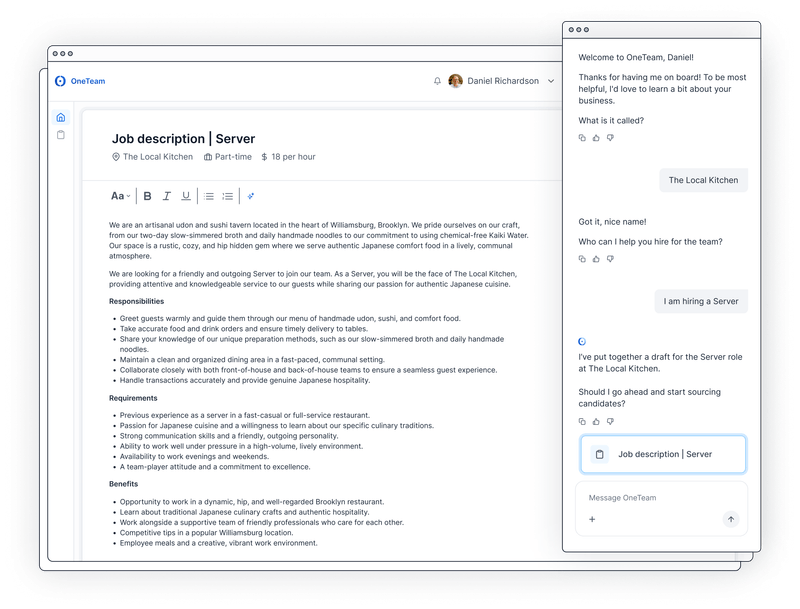
Restaurants hiring frequently often use systems like OneTeam to standardize hiring workflows and organize job postings more clearly across locations. Instead of rebuilding listings during every staffing emergency, operators can create more consistent hiring expectations while reducing manual hiring work.
This becomes especially important for restaurants managing frequent turnover or multiple locations at once. Using tools like an AI job description generator can also help managers structure responsibilities more clearly without spending hours rewriting listings after service or between shifts.
Common Mistakes That Weaken Restaurant GM Job Descriptions
1. Writing for HR Instead of Operations
Most restaurant hiring problems start when job descriptions sound disconnected from the floor. Operators want specifics, not corporate language.
2. Creating Unrealistic Responsibility Lists
Some postings combine GM responsibilities, HR duties, marketing oversight, accounting, recruiting, and district management into one role. Experienced candidates notice immediately.
3. Avoiding Operational Details
Restaurants sometimes hide staffing instability or scheduling pressure to make the role look easier. That usually creates faster turnover after hiring.
4. Ignoring Hiring Efficiency
Managers already lose hours reviewing resumes and coordinating interviews manually. A poor job description increases irrelevant applications and slows hiring further.
Restaurants using structured hiring software or an applicant tracking system often improve hiring speed simply because job expectations become more standardized and organized.
The Link Between Job Descriptions and Retention
Most operators think turnover starts after hiring. In reality, turnover often starts with the job description itself.
When expectations are unclear:
- candidates misunderstand the workload
- ownership and management expectations clash
- scheduling frustrations grow faster
- operational stress compounds early
A stronger restaurant general manager job description creates alignment before onboarding even begins.
That alignment helps:
- reduce early resignations
- improve hiring confidence
- stabilize management teams
- strengthen operational consistency
Restaurants that treat hiring reactively usually repeat the same staffing problems every few months.
Why Top Candidates Ignore Generic Job Postings
Experienced restaurant general managers can recognize template job descriptions immediately. If the posting sounds interchangeable with retail, hospitality, or generic business management, strong operators often skip it entirely.
Top candidates want to see:
- operational structure
- leadership authority
- staffing expectations
- service standards
- labor accountability
- growth potential
- ownership involvement
They also want evidence that the restaurant has organized hiring systems instead of chaotic hiring processes built around emergencies and constant turnover.
That is why many operators now review resources about top features to look for in an ATS or explore AI tools for generating job descriptions to improve hiring consistency across locations.
FAQ


No setup fees.
No long-term commitment.
Create your account and start hiring.
