
15 Interview Questions for Restaurant Staff to Find Top Talent
TL;DR
The best restaurant hires are revealed through behavioral and situational questions, not rehearsed answers. Ask about real shifts, difficult guests, and team conflicts. Use follow-up prompts to push past prepared responses and see how candidates truly think under pressure.

Helgi



In a city like New York, where good staff have plenty of options, one bad hire can set you back fast. That pressure makes it easy to rush an interview and regret it later. The cost shows up in guest complaints, teammates picking up the slack, and the cycle of posting, interviewing, and onboarding all over again.
The right interview questions for restaurant staff cut through the noise. Instead of prompts, candidates can rehearse at home. These questions put people in real situations and show you how they actually think and respond. This guide gives you 15 that actually work, organized by what you're trying to learn.
Why Most Restaurant Interviews Miss the Mark
Questions like "What are your strengths and weaknesses?" won't tell you if someone can hold it together when table 12 is losing patience, and the kitchen is backed up. Behavioral and situational questions get you closer to the truth, fast.
What you actually need to know is:
- How does this person act when a table sends back three dishes at once?
- How do they handle a coworker who isn't pulling their weight on a Friday night?
- Do they take ownership when something goes wrong, or do they point fingers?
What to Look for in a Restaurant Staff Interview
Strong restaurant staff typically show up with:
- Composure under pressure: They don't fold during a rush
- Customer service instincts: They know how to read a guest
- Team-first mentality: They step in without being asked
- Reliability: They show up, on time, every time
- A learning mindset: They're coachable, not defensive
15 Interview Questions for Restaurant Staff
Not every candidate will check every box. But these questions will help you quickly separate the ones worth training from the ones who will ghost you by week two.
Attitude & Work Ethic
1. Tell me about a time you had to push through a really tough shift. What happened, and how did you handle it?
This question reveals grit, resilience, and whether they take ownership of hard situations, not just the easy ones. Follow up with:
- What made it tough? Was it the volume, a team issue, or something personal?
- Would you handle anything differently looking back?
2. What does a good day at work look like to you?
Simple but revealing. Shows what they value, the rush, the guests, the team dynamic, and whether it matches your work environment. Follow up with:
- What would make a day feel like a waste?
- What keeps you motivated during a slow shift?
3. Have you ever disagreed with a decision made by a restaurant manager? How did you handle it?
Tests maturity and communication style. You want someone who can raise concerns professionally, not one who vents to coworkers or silently checks out. Follow up with:
- Did the situation get resolved?
- What would you do differently now?

Customer Service & Guest Experience
4. Tell me about a time you turned a difficult customer into a happy one.
The guest experience is everything in this industry. This shows whether they stay calm under pressure and take initiative to fix problems. Follow up with:
- What specifically did you say or do?
- Did your manager get involved, or did you handle it on your own?
5. A guest complains that their food is taking too long, but the kitchen is slammed. What do you do?
A practical scenario that tests both composure and problem-solving. There's no single right answer, but you want to hear empathy, communication, and ownership. Follow up with:
- Have you actually been in this situation? What happened?
- How do you keep from getting frustrated with yourself?
6. How do you personalize the dining experience for a regular guest versus a first-timer?
Separates the good from the great. Strong front-of-house staff know how to read people and adjust accordingly. Follow up with:
- Can you give me a real example?
- How do you remember preferences without writing everything down?
Teamwork
7. Tell me about a time a coworker wasn't pulling their weight during a busy service. What did you do?
Critical for kitchen and floor staff alike. You want someone who steps up, not someone who gossips about it, ignores it, or waits for a manager to fix it. Follow up with:
- Did you say anything directly to them?
- How did the rest of the team react?
8. How do you communicate with the kitchen when something goes wrong mid-service?
Front-of-house and back-of-house friction is one of the biggest sources of tension in restaurants. This reveals whether they're a bridge-builder or a blame-passer. Follow up with:
- Has there been a time when things broke down between the floor and the kitchen? What happened?
- What do you think makes front-of-house and back-of-house work well together?
9. Describe a time you helped onboard or train a new team member. What was your approach?
Useful for senior hires or potential leads. Shows leadership instincts and whether they invest in the people around them. Follow up with:
- What was the hardest part of getting them up to speed?
- Would you be interested in taking on a training role in this position?
Problem Solving & Adaptability
10. Walk me through how you prioritize tasks when everything needs to happen at once.
The ability to prioritize tasks under pressure is non-negotiable in a fast-paced restaurant. This tests mental organization, not just attitude. Follow up with:
- What habits do you use to stay organized during a rush?
- What's the first thing you do when a shift starts to spiral?
11. A guest orders a menu item that just ran out, and you didn't know until you went to the kitchen. How do you handle it?
Happens all the time. You want someone who bounces back fast, communicates honestly with the guest, and offers a real solution. Follow up with:
- How do you keep your composure when you have to deliver bad news to a table?
- Have you dealt with this before? What did you do?
12. Tell me about a time you had to adapt quickly to a change mid-shift, a policy change, a new system, or an unexpected situation.
Restaurants pivot constantly. You need people who don't freeze up or complain when the plan changes. Follow up with:
- Was the change communicated well, or were you figuring it out on the fly?
- What helped you adjust quickly?

Reliability & Long-Term Fit
13. What's your availability, and how flexible are you with scheduling?
Straightforward but essential, especially for high-turnover environments. Get specifics upfront to avoid problems later. Follow up with:
- Are there days or shifts that are off-limits for you consistently?
- How much notice do you typically need for schedule changes?
14. Why are you leaving your previous employer, or why did you leave your last restaurant job?
A classic, but useful. Listen for red flags like blaming everyone else rather than honest, self-aware answers. Follow up with:
- What did you like most about working there?
- What would your previous manager say about you if I called them right now?
15. Where do you want to be in your career in a year or two? How does working here fit into that?
You're not just hiring for today, you're building a team. This tells you whether they're looking for a temporary gig or actually want to grow with you. Follow up with:
- Is there a specific role or skill set you're trying to develop?
- What would make you want to stick around long-term?
Tips for Running a Better Restaurant Interview
- Keep it conversational. The best interviews feel like a dialogue, not an interrogation.
- Give them time to think. Silence isn't a bad sign; rushing a candidate usually just gets you rehearsed answers.
- Watch for specifics. Vague answers are less useful than real examples with real detail.
- Be honest about the role. Surprises in week one lead to no-shows in week two.
- Take notes. When you're interviewing multiple people a week, the details blur fast.
Want to Spend Less Time on the Hiring Process?
Having the right interview questions for restaurant staff is important, but it only helps once a candidate is already in front of you.
The hours spent sifting through applications, chasing down no-shows, and coordinating interview schedules are time you could be spending on the floor. That's why many restaurants use automated interview scheduling to eliminate back-and-forth communication and keep hiring moving.
If interviews are only one part of the problem, this guide on how to improve your restaurant hiring process explains how to reduce delays across screening, scheduling, and follow-up.
For restaurants that want to connect candidate sourcing, screening, scheduling, and follow-up in one workflow, ai hiring software can help reduce the manual work that slows hiring down.
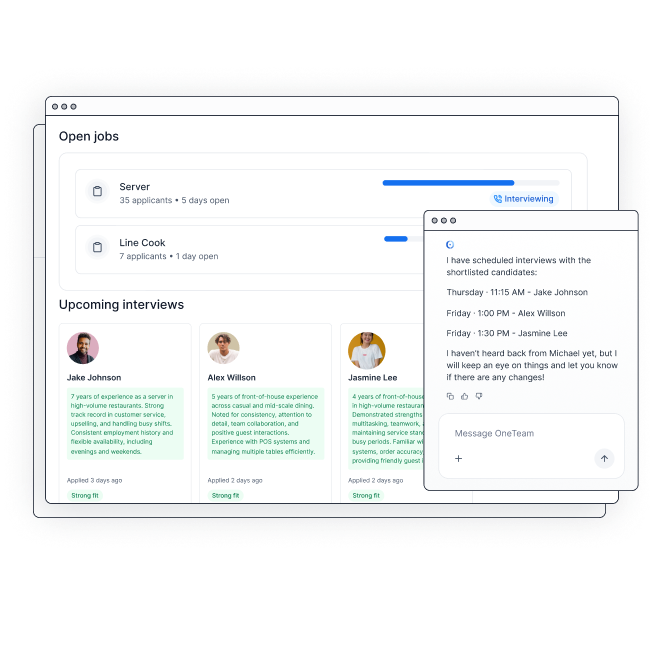
OneTeam is a simple hiring assistant built specifically for restaurants.
- It finds candidates
- Filters out the ones who aren't a fit
- And books the interview for you.
By the time you sit down, you're only talking to people worth your time. You make the final call, OneTeam handles everything before that.
FAQ


No setup fees.
No long-term commitment.
Create your account and start hiring.
